Imagine a scenario where the silence of the board is broken not by the crunching of the pieces., but with the whisper of a melody. Where each movement not only calculates variants, but it evokes emotions, and where strategy merges with harmony in an experience that challenges the senses. Chess and music, of seemingly distant disciplines, have found in festivals a space of unique convergence, creating a universal language that transcends borders and cultures. This merger is not coincidental: both are arts that require concentration, creativity and a deep connection with the present, qualities that we explore in depth in flow and chess. What happens when checkmate becomes a musical note, and the opening of a game resonates like a symphony?
Chess and music: an ancient dialogue between structure and emotion
The relationship between chess and music is not recent. Since ancient times, Philosophers such as Pythagoras and Plato recognized in both fields a mathematical expression of the universe. chess, with its precise rules and its infinite combinatorics, reflects the logic of a score, where each piece has a value and a defined movement, just like every note on a staff. But beyond the theory, What is fascinating is how both languages complement each other in practice.. A study from the University of California revealed that professional musicians have a greater ability to anticipate moves in chess, thanks to his training in rhythmic and spatial patterns. This connection is not merely technical: Music activates the same brain areas as chess, like the prefrontal cortex, responsible for decision making and strategic planning.
At festivals where both disciplines merge, This synergy manifests itself in surprising ways. For example, in it Chess & Music Festival from Berlin, Players compete while a string quartet performs pieces composed specifically for each game. Music is not a simple accompaniment: adapts to the rhythm of the game, accelerating in moments of tension or slowing down in closed positions. This approach not only enriches the sensory experience, but also challenges the traditional perception of chess as a solitary game.. As we point out in Ajedrez and mindfulness, Mindfulness is key to mastering the board, and music acts as a catalyst to reach that state of absolute concentration.
Festivals that redefine the chess experience
The world is full of events where chess and music intertwine, but some stand out for their innovation and ability to transform the perception of the game. One of the most emblematic is the Maribor International Chess and Music Festival, in Slovenia, where participants play on a stage illuminated by projections that translate each movement into artistic visualizations. The music, performed by a live orchestra, It is composed in real time according to the complexity of the game, creating an almost hypnotic atmosphere. This festival not only attracts great teachers, but also to artists and the general public, proving that chess can be an accessible and exciting spectacle.
Another notable example is the Chess in Concert from London, where composers such as Nigel Hess have created works inspired by historical games. In one of his pieces, “The Immortal Game”, Hess musically recreates the famous game between Adolf Anderssen and Lionel Kieseritzky (1851), where each piece sacrifice translates into a change of tonality or rhythm. This approach not only honors the creativity of romantic chess, but also elevates it to a form of performance art. How we explore artistic chess, the beauty of the game goes beyond victory: lies in its ability to inspire and connect with other human expressions.
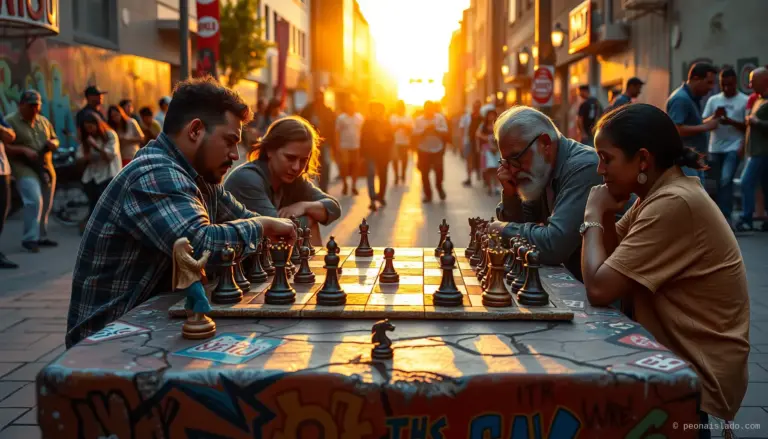
In Latin America, he Chess and Sounds Festival of Buenos Aires has gained recognition for its community focus. Here, chess merges with local musical genres such as tango and folklore, creating a bridge between tradition and innovation. The tournaments take place in public squares, where players compete while street musicians improvise melodies based on the development of the games. This format not only democratizes chess, but also integrates it into everyday life, as another element of urban culture. The experience is similar to the one we describe in street chess, where play becomes an act of resistance and social connection.
The science behind fusion: How music enhances chess performance
The connection between chess and music is not just aesthetic: has solid neuroscientific foundations. Research from the Max Planck Institute has shown that listening to classical music during chess games improves calculation ability and reduces stress. This is because music activates the brain's reward system., releasing dopamine, a neurotransmitter associated with motivation and concentration. In an experiment carried out in Chess & Music Symposium from New York, Players who heard Bach pieces during a tournament showed a 20% fewer errors in complex tactical positions, compared to those who played silently.
But the impact goes beyond individual performance.. Music also facilitates socialization in competitive environments, breaking the barrier of seriousness that often surrounds chess. In it New Orleans Chess and Jazz Festival, the participants don't just play, but they also improvise in jazz sessions after games. This dynamic encourages creativity and collaboration, essential qualities in modern chess, where theoretical preparation and teamwork are as important as individual talent. As we point out in couple chess, play can be a reflection of our human interactions, and music acts as a facilitator to build deeper connections.
The future of festivals: technology, inclusion and new narratives
Chess and music festivals are evolving thanks to technology and an increasingly inclusive approach. In it Chess & Tech Festival from San Francisco, Artificial intelligence algorithms are used to compose music in real time based on the games. These systems analyze the structure of the position on the board and generate melodies that reflect the tension, the balance or chaos of the game. This breakthrough not only opens up new creative possibilities, but also brings chess closer to younger audiences, accustomed to digital interactivity.
Inclusion is another fundamental pillar in the new generation of festivals. Events like the Chess & Music for All in Barcelona they offer accessible workshops for people with visual or hearing disabilities, using adapted boards and vibration systems that translate movements into tactile sensations. The music, in this context, becomes a therapeutic tool, how we explore therapeutic chess, where play is used to improve mental and emotional health. These festivals not only celebrate the fusion of two arts, but they also promote values such as diversity and equity.
Besides, festivals are adopting broader narratives, linking chess and music with social and political issues. In it Chess & Resistance Festival from Berlin, The games are accompanied by protest music and debates about freedom of expression. This approach transforms chess into a symbol of resistance, as it was during the Cold War or in contexts of oppression, as we document in chess in dictatorships. The music, in these cases, reinforces the message that chess is not just a game, but a tool for social change.
Conclusion: a sensory checkmate
Festivals where chess and music merge are much more than cultural events: They are laboratories of creativity, inclusion spaces and platforms to redefine what it means to play. In a world where technology and immediacy threaten to dehumanize chess, These experiences remind us that the game is, first of all, an artistic and emotional expression. Music not only enriches the board experience, but also invites us to see chess from a more holistic perspective, where strategy and sensitivity intertwine.
If you've ever felt like chess is a cold or lonely game, these festivals will show you otherwise. They challenge you to listen with your eyes, to calculate with the heart and to discover that, at the crossroads between silence and melody, hides one of the most enriching experiences that human beings can create. As the great teacher and composer Mark Taimanov said: “Chess is the music of thought”. Are you ready to let that music resonate with you?