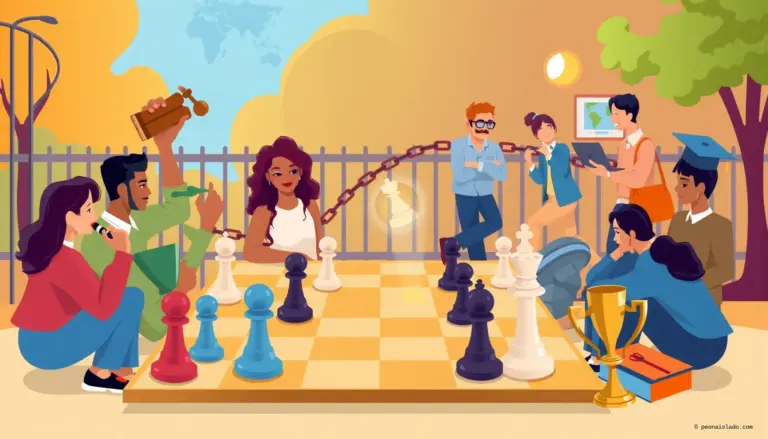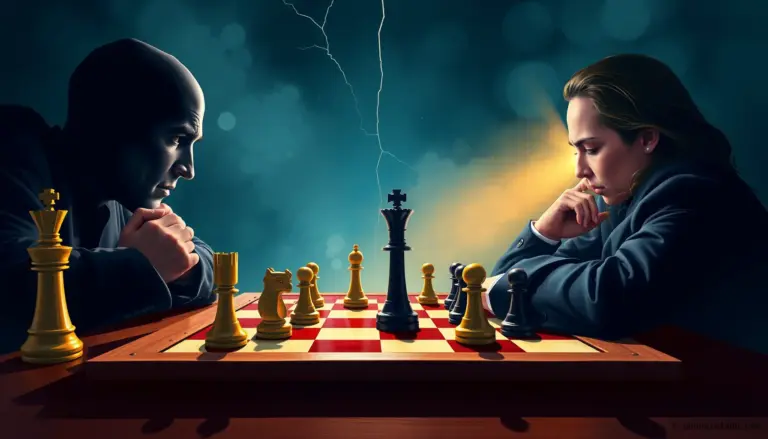
Imagine for a moment that your mind is a chess board. Each piece represents a work concern: the bishop, that urgent email that you can't answer; the horse, the impromptu meeting that messes up your agenda; the tower, the project that stretches like an infinite check. Now, visualize how, by moving those pieces with strategy, chaos becomes order. It's not magic, but neuroscience. Recent studies show that chess acts as a mental gym capable of reducing cortisol—the stress hormone—in a 27% after alone 30 minutes of play. But, Why does this ancient pastime have such a profound impact on our occupational health?? The answer is not only in the 64 casillas, but in how the game reconfigures our brain circuits, teaching us to navigate pressure with the same precision with which a grandmaster anticipates a mate in five moves.
Chess as resilience training: beyond the “game of kings”
Work stress is not an external enemy, but an internal response to the perception of threat. This is where chess becomes an unexpected ally. A study published in Frontiers in Psychology (2022) revealed that regular players develop a greater tolerance for ambiguity, a key trait for managing uncertainty in work environments. The reason is fascinating: Each game requires evaluating multiple scenarios in real time, training the brain to process information under pressure without falling into analysis paralysis. This ability, known as cognitive flexibility, It is the same that allows an executive to pivot strategies when a market collapses or a doctor to make critical decisions in seconds..
But chess not only improves response capacity; also restructures the way we process failure. In the workplace, a mistake can feel like an emotional checkmate, but on the board, every defeat is a lesson in disguise. According to clinical psychologist Jane McGonigal, author of SuperBetter, Chess players develop a more robust growth mindset because they internalize that progress is not linear. This explains why companies like Google and Microsoft have incorporated chess workshops into their wellness programs.: not to create geniuses, but to cultivate employees who see challenges as learning opportunities, not as threats.
To delve deeper into how chess alleviates anxiety from a therapeutic perspective, We invite you to explore our article on therapeutic chess, where we analyze clinical cases that demonstrate its effectiveness in high pressure environments.
The effect “flow”: when the dashboard silences work noise
Have you ever lost track of time while solving a complex problem?? That state of absolute concentration, where the outside world fades away, es lo que el psicologe Mihály Csíkszentmihályi denominator flow. Chess is one of the few games that induces this state easily., thanks to its unique combination of intellectual challenge and immediate reward. A study from the University of California (2021) found that players who achieve flow during a game experience a reduction in 40% in the activity of the amygdala—the brain region associated with fear and anxiety—.
In the work context, flow is the antidote to multitasking, that modern habit that fragments our attention and increases stress. When you feel overwhelmed by simultaneous tasks, A game of chess—even against an AI engine—can act as a reset mental. The key is in the mindfulness: by focusing on calculating variants, your brain “forget” temporarily external concerns, allowing the parasympathetic nervous system—in charge of relaxation—to take control. This principle is the basis of programs like Ajedrez and mindfulness, that integrate the game with meditation techniques to enhance its benefits.
But the flow is not exclusive to the experts. Even beginners can experience it when solving simple tactical problems, like a mate in two. The feeling of accomplishment when finding the solution releases dopamine, a neurotransmitter associated with motivation and pleasure, that counteracts the effects of chronic stress. In the words of Grandmaster Garry Kasparov: “Chess is the gymnastics of the mind, but also your massage”.
The paradox of control: how losing teaches you to win at work
One of the biggest generators of work stress is the feeling of lack of control. Projects with tight deadlines, Unpredictable bosses or volatile markets can make you feel like you're playing a game where the rules are constantly changing.. This is where chess offers a counterintuitive lesson.: learning to lose is the best strategy to win.
An experiment carried out at the University of Oxford (2020) divided to 200 professionals in two groups: one received chess training for three months, while the other continued with his usual routines. The results were revealing: the chess group showed a 32% less reactivity to stress in situations of uncertainty, such as organizational changes or performance evaluations. The researchers attributed this effect to the fact that chess teaches accept imperfection. on the board, even world champions make mistakes; the difference is in how they manage them. This mentality carries over to the workplace.: instead of obsessing about avoiding failures, players learn to recover from them quickly, reducing rumination—that negative self-talk that amplifies stress.
Besides, chess encourages pattern-based decision making, not in impulses. Every move forces you to evaluate risks and rewards., a skill transferable to negotiations, team management or even personal financial planning. As neuroscientist David Eagleman points out in his book The Brain, “Chess is a real-time life simulator, where every decision has immediate and measurable consequences”. This constant feedback trains the brain to anticipate results, reducing anxiety associated with the unknown.
If you are interested in how chess can transform your job performance from a practical perspective, Don't forget to read our analysis on chess in companies, where we break down real cases of corporations that have integrated gaming into their professional development programs.
Chess as a universal language: human connection in the digital age
Work stress is not only individual; It is also social. The loneliness of teleworking, excessive competition or lack of recognition can erode emotional well-being. Here, chess emerges as a bridge between people, regardless of your culture, language or hierarchical position. A study from Harvard University (2023) showed that employees who participated in chess games with colleagues reported a 23% more job satisfaction and a 18% less interpersonal conflicts. The reason is simple: the board levels the ground. In a game, It doesn't matter if you are the CEO or the intern; the only thing that counts is your ability to think strategically.
This community effect is especially valuable in remote environments, where emotional disconnection is a growing risk. Platforms like Lichess or Chess.com have created virtual spaces where players can compete, but also chat, analyze games or even participate in corporate tournaments. The social interaction that arises from these games acts as a stress buffer, similar to what happens in street chess clubs, where play becomes a ritual of belonging.
But chess doesn't just connect; also humanizes. In an era where work interactions are often reduced to emails or Slack messages, A game of chess forces you to read your opponent's body language, to anticipate their emotions and celebrate—or console—their successes and mistakes. This empathy carries over into professional life, improving communication and reducing misunderstandings. As the philosopher Emmanuel Lévinas said: “The face of the other is the first board where ethics is played”. in chess, that face could be that of a colleague, a customer or even a competitor.
From theory to practice: how to integrate chess into your work routine
The stress-reducing benefits of chess are backed by science, but how to apply them on a daily basis? The key is in the dosage. You don't need to spend hours studying openings or solving complex problems; It is enough to incorporate small habits that activate the brain mechanisms that we have described:
- Micro-games during breaks: 10 quick chess minutes (blitz) on your phone they can reset your mind between meetings. Apps like Chess.com They offer games with adjustable time, ideal for short breaks.
- Tactical problems as a mental exercise: solve a mate in two or a material gain exercise activates dopamine and improves concentration. Platforms like Lichess They have sections dedicated to free tactics.
- Social chess: Organize games with co-workers, either in person or online. The playful component reduces tension and fosters camaraderie.
- Game analysis: Review your games—even lost ones—with tools like ChessBase o Lichess Study helps you identify thinking patterns and improve your decision making.
- Routines “conscious chess”: Combine the game with breathing techniques. For example, before moving a piece, take three deep breaths to activate the parasympathetic system.
A curious fact: companies like Siemens have implemented “chess rooms” in their offices, where employees can play quick games during their breaks. The results are eloquent: and 30% less absenteeism due to stress and an increase in 15% in productivity in teams that participate in internal tournaments. As organizational psychologist Adam Grant points out:, “chess is not just a game; It is a metaphor for how we approach challenges. Those who practice it develop a more resilient mentality, creative and collaborative”.
For those seeking to bring these benefits to the educational or therapeutic field, our article on chess in education offers detailed guidance on how play can be integrated into cognitive and emotional development programs.
Conclusion: the board as a mirror of your well-being
Chess is not a panacea, but it is a powerful tool to manage work stress from its roots.: the mind. Its beauty lies in its simplicity —64 squares, 32 pieces—and in its infinite complexity, reflecting the challenges of modern life. Every game is a reminder that, even in high pressure situations, we have the ability to choose our response: we can surrender to chaos or, like a good player, turn it into a chance to shine.
Science has shown that chess reduces cortisol, improves decision making and fosters resilience, but its true value transcends the quantifiable. In a world where work stress has become a silent epidemic, the board offers something more valuable than victories: the certainty that, with strategy and patience, Even the most complex problems have a solution. As the writer Stefan Zweig said: “Chess is proof that human intelligence can create beauty even in defeat”.
So the next time you feel like work is overwhelming you, remember: somewhere in the world, two people are sitting in front of a board, moving pieces calmly, calculating variants and, without knowing it, training their minds to face stress with the same elegance with which a bishop crosses the board diagonally. Why not join them?