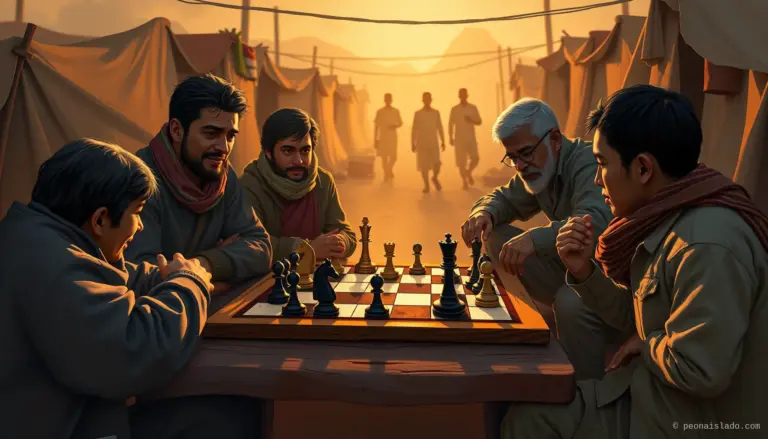
chess, that board 64 boxes where intellectual battles are fought, has historically been a reflection of social structures. For centuries, women were relegated to secondary roles, as spectators or decorative pieces in a game dominated by men. However, Women's chess has undergone a radical transformation in recent decades, going from being a marginal space to one of the most dynamic and revolutionary fronts of mental sports. How did you manage to break gender barriers in such a competitive field?? What challenges persist in the search for equity? Y, above all, What does this evolution reveal to us about the power of talent when faced with entrenched prejudices??
From invisibility to headlines: the first steps of women's chess
The history of women's chess is marked by figures who defied the expectations of their time. In the 19th century, when the game was already a symbol of intelligence and strategy in Europe, Women who dared to compete did so under unequal conditions. A paradigmatic example is that of Vera Menchik, the first major women's world champion (1927-1944), who not only dominated the circuit with an iron fist, but also competed against men in open tournaments, something unthinkable for most of his contemporaries. Menchik showed that gender did not determine strategic capacity, but his legacy was overshadowed by the prevailing machismo: many of her male rivals refused to acknowledge her victories, arguing that “a woman couldn't play so well”.
This prejudice was not accidental. chess, as mirror of civilizations and power, reproduced the hierarchies of society. In the Middle Ages, For example, The Church banned the game for women on the grounds that it “distracted from his domestic duties”, an excuse that was repeated in different historical contexts. However, The 20th century brought profound changes. The creation of the Women's World Championship in 1927, powered by FIDE, It was a first step towards the institutionalization of women's chess, although still within a segregated framework. The question that arises is inevitable: Was this segregation a necessary concession to give visibility to the female players?, or a way to perpetuate the idea that chess “elite” it was still a male territory?
The Polgár sisters and the Hungarian revolution: genius or training?
If Vera Menchik opened the door, the sisters Judith, Susan and Sofia Polgár they knocked her down. Raised under a unique educational experiment by their father, László Polgár—who believed that “geniuses are not born, are made”—, These three Hungarian women showed that chess talent had no gender. Susan was crowned women's world champion in 1996, Sofia achieved spectacular victories in open tournaments, and Judith, the youngest, She became the best player in history by reaching the position 8 of the absolute world ranking in 2005, a record that has not yet been surpassed by any woman.
The Polgár case is fascinating because it challenges two myths simultaneously: that of female inferiority in chess and that talent is innate. His success was based on an intensive training method since childhood, but also in an environment that protected them from stereotypes. As the article on chess prodigies, The debate between nature and nature is still open, but the truth is that the Polgárs showed that, with the same opportunities, women could compete at the highest level. However, His story also poses a paradox: if the Polgár method was so effective, Why was it not massively replicated in other countries?? The answer could be that, beyond training, A cultural change was needed that is still in process.
The effect “Queen's Gambit”: when women's chess became mainstream
In October 2020, Netflix released The Queen’s Gambit, a series that not only became a global phenomenon, but it redefined the perception of women's chess. The protagonist, Beth Harmon, an orphan with an exceptional talent for the game, captivated millions of viewers and generated an unprecedented increase in board sales and women's enrollment in chess clubs. According to FIDE data, in 2021 The number of registered female players grew by 60% compared to the previous year, a leap that many attribute directly to “Harmon effect”.
But, What made this series resonate so much?? Beyond its narrative quality, The Queen’s Gambit presented a complex protagonist: bright, but also vulnerable; ambitious, but self destructive. Beth was not the “perfect woman” that is often required of female figures in sport, but a human character, with flaws and contradictions. This, added to his mastery of the board, made her a symbol of empowerment for many women. However, as analyzed in the article on fact or fiction in elite chess, The series also simplified some aspects of the competitive world, such as psychological pressure or access to resources, that remain real barriers for female players.
The impact of the series was so profound that even the current women's world champion, Ju Wenjun, declared in an interview: “Beth Harmon reminded me why I love chess”. But beyond the anecdotes, the true legacy of The Queen’s Gambit It could be having normalized the idea that women can—and should—aspire to be the best at a game that was denied to them for centuries..
Current challenges: gender gap, awards and representation
Despite the advances, women's chess continues to face structural obstacles. One of the most obvious is the gap in financial prizes. In 2023, the Absolute World Championship distributed 2 million dollars, while the feminine gave just 500.000. This difference not only reflects economic inequality, but also a symbolic hierarchy: chess “masculine” continues to be perceived as more prestigious. As the article on chess and gender, this segregation in tournaments—even when it is “positive” to give visibility to women—can perpetuate the idea that women's chess is a separate category, and not just chess.
Another challenge is representation in leadership positions. Although FIDE has had female vice presidents, as Susan Polgar, Chess governing body remains predominantly male. This translates into policies that do not always respond to the specific needs of female players., such as the lack of sponsorships or the limited media coverage of women's tournaments. For example, in the Candidates Tournament 2022-2023, where it was decided who would challenge the world champion, The games received less publicity than those of the equivalent men's tournament, despite the fact that the players - like Lei Tingjie o Alexandra Kosteniuk— offered an exceptional technical level.
Besides, stereotypes persist that affect female participation. A study from the University of Oxford revealed that, in school tournaments, girls are often discouraged by their own coaches or peers, who tell them that “chess is for children”. These types of microaggressions, added to the lack of female models in the media, contribute to many leaving the game before reaching their potential. The solution is not simple, but initiatives such as chess programs in schools —where the game is taught without distinction of gender—are proving effective in closing this gap from the ground up.
The future: towards a chess without gender labels
The current panorama of women's chess is hopeful, but also contradictory. On the one hand, There have never been so many high-level female players before.: in 2024, there are more than 1.700 women with the title of Grand Master, in front of the barely 30 what was in 1990. Countries like China, Russia and Georgia have developed training systems that consistently produce champions, and figures like Hou Yifan (former world champion) o Tan Zhongyi (current champion) They are global references. On the other hand, the glass ceiling is still intact: no woman has come close to winning the Absolute World Championship, and the debate on whether women's chess should remain a separate category remains open.
some voices, like that of Judit Polgár, They advocate eliminating gender distinction in tournaments, arguing that “chess has no gender, it only has players”. Others, like that of Alexandra Kosteniuk, They defend that women's tournaments are necessary to give visibility and opportunities to female players. The truth is that, as long as prize inequalities persist, sponsorships and representation, segregation will continue to be a necessary evil. However, the ultimate goal should be a chess where gender does not determine opportunities, but talent and effort.
In this sense, the role of the new generations will be key. Players like Rameshbabu Vaishali (sister of the prodigy Rameshbabu Praggnanandhaa) o Bibisara Assaubayeva (the Kazakh who with 16 years she was already Grand Master) They are breaking records and showing that the future of women's chess is bright. But beyond individual achievements, The real change will come when chess stops being a space where women must “demonstrate” its worth, and it becomes a game where everyone, regardless of gender, can compete on equal terms.
Women's chess has come a long way since the days of Vera Menchik, but the journey is far from over. Every game played by a woman in an open tournament, every girl who is inspired by Beth Harmon to sit in front of a board, and every father who encourages his daughter to compete without prejudice, It is a step towards a future where chess is, simply, chess. As he once said Garry Kasparov: “Chess is the fight against error”. In the case of women's chess, that fight has been against the errors of a society that for too long underestimated the talent of half of humanity. And although there are still errors to correct, the checkmate of prejudice is getting closer.