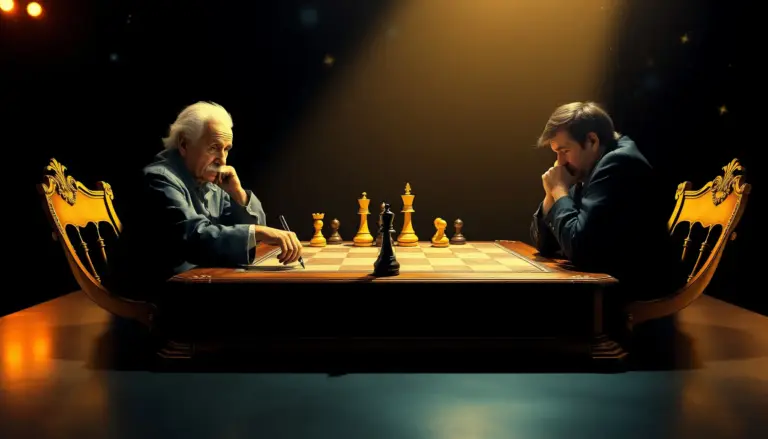
Chess is not just a strategy game, but a mirror of the human condition. Each game is a silent dialogue where two minds confront each other, but they are also recognized. On that board 64 casillas, the empathy emerges as a hidden ability: Anticipating the opponent's movements is not just calculating variants, but understand their intentions, their fears and even their mistakes. How does chess teach us to put ourselves in someone else's shoes?, even when the goal is to beat him?
The board as a setting for the theory of mind
Theory of mind—the ability to attribute mental states to others—is one of the most sophisticated cognitive abilities of human beings.. in chess, This ability is activated almost instinctively. A player not only evaluates positions; interpreta to the opponent. Why did that pawn advance?? Is it a trap or a bug? Are you nervous or confident? This psychological reading, that goes beyond the tactical, It is what differentiates great teachers from mere calculators. Studies in chess neuroscience have shown that the brain areas associated with empathy, like the prefrontal cortex, are activated during complex games, even in amateur players.
But empathy in chess is not one-way. It also implies self-knowledge: recognize our own emotions to avoid falling into psychological traps. A player who masters this duality—understanding his opponent and himself—has an advantage that no AI engine can replicate.. As the psychologist and chess player Jonathan Rowson points out, “Chess is a laboratory where we practice the ethics of care: pay attention to others without losing sight of our own objectives”.
Chess as a tool of inclusion and connection
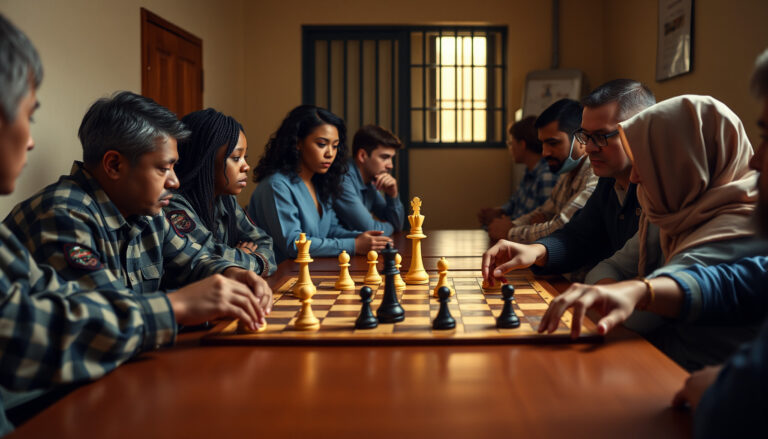
The power of chess to generate empathy transcends the board. In contexts of conflict or exclusion, the game becomes a bridge. In programs in Jerusalem, Israeli and Palestinian children compete in tournaments where the only common language is that of the pieces. There are no political speeches, only movements that require anticipation and respect. The same happens in refugee camps, where chess offers structure and hope to those who have lost everything.
This ability to connect is not accidental.. chess, being a game without linguistic or cultural barriers, allows two people to communicate through strategy. In a study carried out in schools in Medellín, It was observed that children who participated in chess workshops They developed greater tolerance for frustration and conflict resolution skills, skills directly linked to empathy. The board thus becomes a microcosm where social dynamics are rehearsed.: cooperation, healthy competition and recognition of the other.
The paradox of the rival: empathy in competition
Chess poses a fascinating paradox: to win, you must understand your opponent, but you also have to get over it. This tension between connection and confrontation is what makes the game a metaphor for life.. In the game, as in existence, we can't always choose our adversaries, but how do we face them. An empathetic player does not underestimate his opponent; studies it, respects him and, sometimes, even admires him.
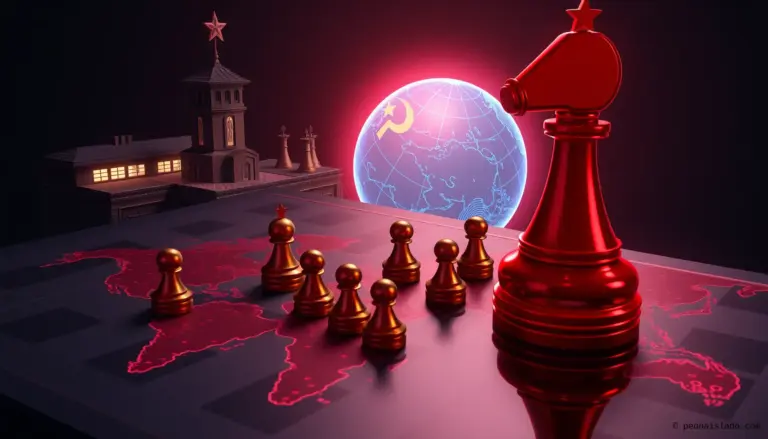
This dynamic is evident in historical games such as Fischer vs. Spassky (1972), where the political rivalry between the US. and the USSR moved to the board. However, beyond the cold war, What remained was the mutual recognition of two geniuses who, despite everything, They shared the same passion. Fischer, in his memories, admitted that he missed playing against Spassky because “He understood his style like no one else.”.
Empathy in chess also manifests itself in small but significant gestures: offer boards in a balanced position, acknowledge a mistake without excuses or congratulate your opponent for a brilliant play. These acts, apparently minor, They are the ones that humanize the game and turn it into something more than an intellectual exercise.
Therapeutic chess: heal through strategy
If chess teaches empathy in competition, He also does it in healing. In therapies for young people with depression o veterans with PTSD, the game acts as an emotional catalyst. By focusing on the pieces, patients learn to regulate their emotions, to anticipate consequences and, above all, to see the world from another perspective. The board becomes a safe space where mistakes have no real consequences., but valuable lessons.
El psiquiatra Vladimir Rašković, pioneer in the use of chess in mental health, explains that “the game forces the patient to come out of his egocentrism. When they analyze a game, they don't just see their mistakes, but also those of the rival, which helps them relativize their own problems”. This decentralization of the self is, in essence, the core of empathy: understand that the world does not revolve around our worries.
Empathy as a competitive advantage
In a world obsessed with victory at any price, chess offers a contrary lesson: empathy can be a strategic advantage. The players who achieve to feel rival's intentions—without falling into the trap of projecting their own insecurities—make more precise decisions. This is clearly seen in the style of players like Magnus Carlsen, known for its ability to “file” your opponents and adapt to their psychological weaknesses.
But empathy in chess is not limited to tactics.. It also influences how players handle defeat.. An empathetic chess player does not blame his opponent for his victory, but he recognizes his own mistake. This humility, grown on the board, carries over into everyday life, where the ability to put yourself in someone else's shoes is key to healthy relationships and more just societies.
Ultimately, Chess is much more than a game of kings and pawns. It is a school of humanity where each game teaches that, to advance, first you have to understand. In an increasingly polarized world, This lesson—learned in silence about 64 boxes—could be the most valuable of all.
The board reminds us that, even in the fiercest competition, there is always room for connection. And maybe that's the real checkmate: discover that, in the end, the rival is not an enemy, but a mirror.