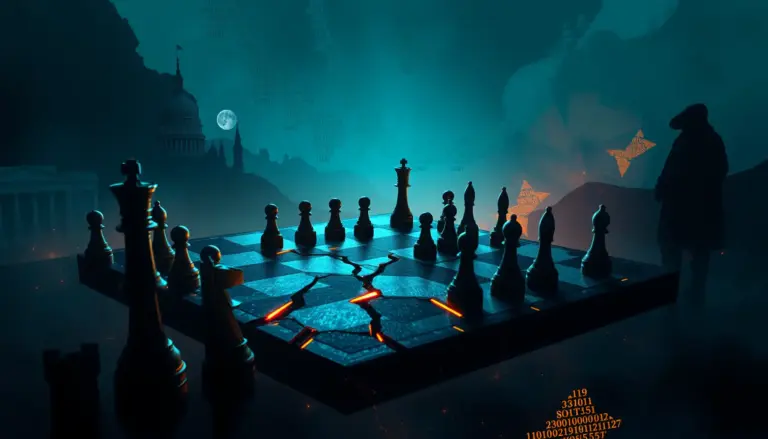
In the heart of Moscow, behind a black marble façade and armored doors, There is a chess club where the games do not end with a simple handshake. Here, moves on the board can decide fortunes, political careers and even national destinies. It is not a place for amateurs: its members are oligarchs, retired spies, tech moguls and masters who have sacrificed more than pawns on their way to checkmate. This is the Club of the 64 Paintings, the most exclusive—and dangerous—circle in world chess. What makes it unique? It's not just the level of play, but what is at stake.
Chess has always been a reflection of power, but in this club, becomes your sharpest tool. The rules are clear: no one talks about what happens inside, and the games are not recorded. The boards are made of ebony and ivory, hand-carved by artisans sworn to silence. And although the outside world ignores it, Its echoes resonate in decisions that change the course of history. Welcome to the dark side of the ancient game.
The origin: where chess stopped being a game
Legend has it that the club was born in 1956, during the Amsterdam Candidates Tournament. A young Bobby Fischer, then with just 13 years, was invited to a game “private” in a suite at the Krasnapolsky Hotel. His rival was none other than a KGB general, who offered him a deal: win the game and you would receive a US passport; lose, and his family in Brooklyn would suffer the consequences. Fischer won, but he never talked about the episode. that night, Chess stopped being a sport and became a silent battlefield..
He Club of the 64 Paintings It was formalized decades later, in the years 90, when the fall of the USSR left a power vacuum that the nouveau riche and the intelligence services filled with high-risk items. Its original headquarters were in a bunker under the Metropol Hotel., but today he operates from a mansion in Rublyovka, the most exclusive neighborhood in Moscow, where properties are worth more than some countries. To be a member, It is not enough to be a great teacher: you have to show loyalty, discretion and, above all, that you have something valuable to lose.
Chess has always been linked to power and politics, but in this club, the line between the board and reality fades. Here, A Queen's Gambit May Be The Prelude To A Covert Operation, and a long castling, the signal for a regime change. Members do not play for trophies, but for information, influence or survival.
The unwritten rules: what you will never see in an official tournament
In it Club of the 64 Paintings, FIDE rules are just a starting point. True rules are transmitted in whispers and reinforced with consequences. These are some of the best known:
- time does not exist: There are no clocks. Games can last hours, days or even weeks. The goal is not to win quickly, but to wear down the rival until he makes an irreversible mistake. This practice has a name in the club: the torture of the laborer, a reference to how the opponent is psychologically pressured until his resistance breaks.
- The pieces have a price: Each move can be backed by an external agreement. A sacrificed bishop could mean the sale of shares in a company; a lost horse, the resignation of an official. In 2014, a Swiss banker lost a game against a Russian tycoon and, the next day, Your financial institution was nationalized. Coincidence or consequence, no one confirmed it.
- Silence is mandatory: Talking during a game is prohibited, but not for the reasons you imagine. It's not about concentration, but to prevent conversations from being recorded. Boards are microphone shielded, and members sign confidentiality agreements that include perpetual silence clauses. Breaking this rule has an exemplary punishment: the exile of the club and, in some cases, something worse.
- There are no referees: Disputes are resolved with a tiebreaker game, but not on a conventional board. It is used the shadow chess, a variant where the pieces move in the dark and only light up when they are captured. Winning in these conditions requires not only skill, but a prodigious memory and nerves of steel.
These rules turn the club into a unique ecosystem, where chess merges with world of conspiracies and geopolitical intrigues. But the most fascinating thing is not the rules, but the players who accept them.
The members: profiles of an unscrupulous elite
The club has 64 members, one for each square on the board. Each position is for life, and is only released when its occupant dies or is expelled. These are some of the most notable profiles:
- The Tsar: A former FSB agent who now runs an investment fund. His playing style is cold and calculating, like your career. It is rumored that he was the one who orchestrated the departure that bankrupted a Ukrainian oligarch in 2018. never lose, because he always has a contingency plan.
- The Red Queen: A woman of Georgian origin, former women's world champion, who now advises governments on security strategies. His specialty is the poisoned queen's gambit, an opening he uses to test the loyalty of his rivals. If they accept the sacrifice, earn your trust; if they reject it, are marked as enemies.
- The Technological Bishop: A Silicon Valley billionaire who funds artificial intelligence startups. His obsession is to create an algorithm capable of beating any human in a club game.. Until now, has failed, but its advances have redefined the chess in the digital age.
- The Pawn: The youngest member, a prodigy of 19 years recruited in a youth tournament. Its function is simple: lose. But not any loss. You should do it in a way that makes it look like a natural mistake., without revealing that he is following orders. It is the most dangerous position, because one day, if you demonstrate sufficient skill, will amount to a larger piece. The will disappear.
These players are not just masters of the board; They are strategists who have taken chess to a level where every move has real consequences.. But the club would not be what it is without its most legendary games, those that have gone down in history as examples of how the game can change the world.
Games that made history: when the board decided the destiny
In it Club of the 64 Paintings, the most famous games are not recorded in databases or analyzed in books. They are transmitted orally, from generation to generation, like legends. These are three of the most impressive:
- The Departure of the Three Presidents (1999): In a private room at the club, the president of a central European country faced each other, an oil tycoon and an intelligence chief. The prize was not money, but the control of a state company valued in billions. The tycoon won, but the next day, The president was removed in a coup d'état. The company was never privatized. Coincidence? The club members know that.
- The Chernobyl Checkmate (2006): A Russian nuclear engineer and an executive from an energy company played a game where each move represented a decision about the future of a power plant. The engineer sacrificed his queen in the movement 23, and the next day, the plant was closed by “security reasons”. The executive, for his part, received a block of shares from a rival company.
- The Departure of Silence (2016): An investigative journalist challenged a club member to a game. The journalist, known for his reporting on corruption, accepted under one condition: if he won, the member would answer three questions under oath. The journalist lost in 17 movements, and the next day, its main source was found dead in an apparent suicide. He was never heard from again..
These games show that in the Club of the 64 Paintings, chess is not a game, but an extension of reality. Each move is a move on a much larger board, where the pieces are people, the boxes are countries, and checkmate can be the end of an era.
The future of the club: a legacy in danger?
He Club of the 64 Paintings has survived cold wars, revolutions and economic crises, but today he faces his greatest challenge: artificial intelligence. He Technological Bishop He is not the only one seeking to create an unbeatable algorithm. Governments and corporations invest millions in developing machines capable of predicting human movements with surgical precision. If they achieve it, the club will lose its reason for being.
But its members are not willing to give up. In 2023, a new rule was introduced: Games can now include items from quantum chess, where the pieces exist in superposition until they are observed. This adds a layer of uncertainty that not even the most advanced AI can resolve.. Besides, The club has begun recruiting hackers and cryptographers to protect its secrets from invading algorithms..
The other great challenge is transparency. In a world where social networks and technology expose even the most hidden secrets, the club must adapt or disappear. Some members advocate opening a “public version” of the club, where the games are broadcast live, but with modified rules to protect players. Others, as The Tsar, They insist that mystery is what makes the club unique. “If everyone knew what we do here, it would stop being dangerous”, he said in a private meeting.
Whatever the future, one thing is for sure: he Club of the 64 Paintings will continue to exist as long as there are those who believe that chess is more than a game. for them, It's a way of life, a tool of power and, in some cases, a lethal weapon.
Chess has always been a mirror of humanity, but in this club, becomes your shadow. Here, movements are not judged by their beauty, but for its effectiveness. Games are not won with genius, but coldly. And the players are not athletes, but strategists willing to do anything for the final checkmate. If you are ever invited to play, remember: on this board, there are no rules. Only consequences.
He Club of the 64 Paintings It is not only the most exclusive chess club in the world. It is the place where gambling stops being a hobby and becomes a matter of life or death.. And although the world ignores it, Their games continue to decide the destiny of nations, companies and people. in chess, like in life, the important thing is not to win. It's not losing.