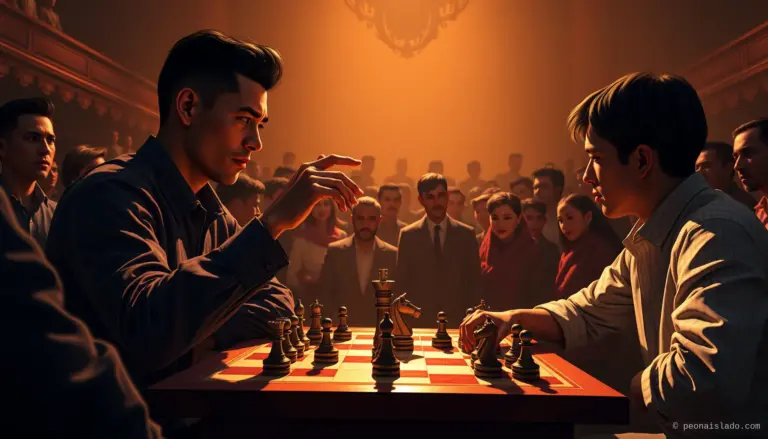
Chess has witnessed geniuses who transformed its essence, from the romantic sacrifices of Rudolf Spielmann to the scientific precision of Wilhelm Steinitz. However, Few players have redefined the game like Magnus Carlsen in 2013, when he took the world title from Viswanathan Anand in Chennai. His victory was not just a changing of the guard, but the beginning of an era where efficiency surpassed tactical brilliance, challenging the idea that chess had to be a fireworks show to be great.
Carlsen, nicknamed the “Mozart of practical chess”, showed that excellence does not lie in the complexity of the plays, but in the ability to turn small advantages into inexorable victories. Your style, often dismissed as “bored” for the purists, revealed an uncomfortable truth: chess is not a beauty contest, but a battle of mental resistance where another's error is punished more severely than one's own creativity.. This article explores how his approach revolutionized the game, redefining what it means to be a champion in the modern era.
The myth of brilliance: why chess is not a fireworks contest
Since the times of Anderssen's Immortal, chess has been associated with the idea of romantic genius, one capable of sacrificing pieces in a fit of inspiration to achieve a spectacular victory. This narrative, although seductive, hides a more prosaic reality: most games are decided by mistakes, not for genius. Carlsen understood this better than anyone. His game was based on a simple premise: accumulate small positional advantages and wait for the rival, under pressure, made a mistake.
This philosophy clashed with the Soviet chess tradition., where the Russian School had dominated for decades with an approach based on theoretical preparation and analytical depth. Carlsen, instead, prioritized the dynamic understanding of the position over the memorization of variants. His game against Anand in the fifth round of the World Cup 2013 is a paradigmatic example: instead of looking for a forced line, opted for a pawn structure that, although seemingly innocuous, limited his opponent's options and forced him to play with surgical precision. The result was a victory that did not depend on a tactical coup, but from the accumulation of small pressures.
The Psychology of Mastery: How Carlsen redefined mental toughness
chess is, in essence, a psychological duel. Carlsen took this dimension to a new level by turning mental resistance into his most lethal weapon.. Unlike previous champions like Bobby Fischer, whose tactical genius was indisputable but whose emotional stability was fragile, Carlsen demonstrated an almost superhuman ability to maintain concentration for hours, even in seemingly equal positions. His strategy was not to win in 20 movements, but exhaust the rival in 60.
This mentality aligns with the principles of zugzwang, a concept where the player who must move is at a disadvantage simply because of the obligation to do so. Carlsen applied this principle not only on the board, but in the minds of his opponents. In the World Cup 2013, Anand, a player known for his speed of calculation, was forced to spend time in positions where there were no clear answers, while Carlsen, imperturbable, was waiting for his chance. The psychological tension became unbearable, and Anand's mistakes in the games 6 y 9 were a direct consequence of this accumulated pressure.
Carlsen's legacy: when efficiency surpasses creativity
Carlsen's victory in 2013 marked a turning point in the history of chess. Your style, although less spectacular than that of its predecessors, showed that excellence does not require heroic sacrifices, but a deep understanding of positional principles and an unwavering ability to exploit other people's errors. This approach has influenced a generation of players who prioritize solidity over creativity., a change that some criticize for “homogenize” the game, but that others celebrate for raising the competitive level.
A clear example of this legacy is the evolution of chess engines.. While in the era of Deep Blue artificial intelligence relied on brute force to calculate millions of variants, today tools like AlphaZero have adopted a more approach “human”, evaluating positions with qualitative criteria similar to those of Carlsen. This suggests that his style is not only effective, but also reflects a fundamental truth about chess: victory does not always belong to the brightest, but to the most resistant.
Chess as a mirror of life: lessons beyond the board
Carlsen's mastery transcends chess and offers valuable lessons for other areas of life. Your ability to remain calm under pressure, Your focus on accumulating small advantages and your willingness to wait for the right moment are skills transferable to business decision making., politics and even personal relationships. In a world obsessed with immediacy, His style reminds us that patience and consistency are usually more powerful than spins..
Besides, His career challenges the notion that success requires exceptional innate talent.. Carlsen was not a prodigy in the classical sense, as they were children who master the game 10 years, but a player who honed his craft through deliberate practice and constant adaptation. His story is a reminder that excellence is not a gift, but the result of methodical work and a resilient mentality.
Conclusion: chess after Carlsen
Magnus Carlsen not only changed the way of playing chess, but also the way to understand it. His reign, which extended until 2023, showed that the game is not an ephemeral art, but a discipline where consistency and mental endurance are as valuable as creativity. In a world where technology and artificial intelligence redefine the limits of what is possible, His legacy lives on as a beacon for those seeking to master the board without relying on occasional genius..
chess, after Carlsen, he is no longer the same. And perhaps that is his greatest victory: have shown that, in a game of infinite possibilities, True mastery lies in the ability to turn the ordinary into the extraordinary..