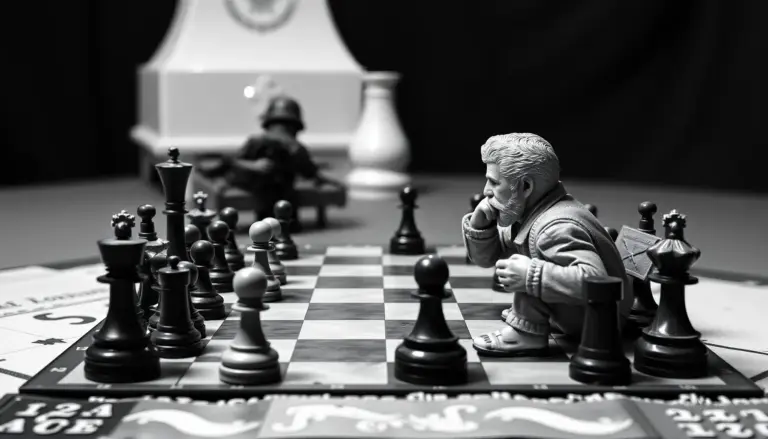
In the history of humanity, war conflicts have left an indelible mark, marking entire eras with violence and destruction. However, There are exceptional moments in which ingenuity, Strategy and even sport have achieved what weapons could not.: temporarily stop the war. One of the most fascinating and least known episodes is the one in which a simple chess match managed to break up an armed confrontation, proving that, even in the darkest moments, Reason and creativity can open unexpected paths to peace. This story not only tells us about an ancient game, but about how human intelligence, when you focus on intellectual competition instead of physical confrontation, can become a bridge to reconciliation. Throughout this article, We will explore the details of this historical event, its context, the key figures who made it possible and the lessons that still resonate today in a world where conflicts seem to have no end.
Chess as a symbol of civilization in the midst of chaos
chess, with its origins in India in the 6th century under the name Chaturanga, It has always been more than just a game. Since its arrival in Persia and its subsequent expansion throughout the Islamic world and Europe, became a reflection of military strategy, philosophy and even diplomacy. In the Middle Ages, kings and nobles used it not only for entertainment, but as a tool to train the mind in the art of war. However, Its true power lay in its ability to transcend cultural and linguistic differences., becoming a universal language.
During the First World War, For example, soldiers from enemy trenches came to share chess games during unofficial moments of truce, like the famous Christmas Truce 1914, where Germans and British put down their weapons to play football and, in some cases, to chess. These gestures, although ephemeral, They showed that even in the midst of hatred and dehumanization, the game could remind combatants of their shared humanity. But the case at hand goes further.: It was not a spontaneous truce, but an event organized with a clear purpose.
chess, in this context, acted as a peace catalyst because its very essence—intellectual competence, respect for the rules and the need to anticipate the opponent's movements—turned him into a microcosm of diplomacy. Unlike other sports, where physical strength or luck can tip the balance, chess requires a deep understanding of the other, a strategic empathy that, In the case that we will analyze, achieved the impossible.
The historical context: The Thirty Years' War and the miracle of Stralsund
To understand how a chess match could stop a war, it is necessary to immerse ourselves in one of the most devastating conflicts in European history: the Thirty Years' War (1618-1648). This confrontation, which began as a religious dispute between Protestants and Catholics, It became a struggle for political and territorial power that devastated much of Central Europe.. Entire cities were looted, populations decimated by hunger and disease, and the mercenary armies roamed freely, without loyalties beyond the payment they received.
In this scene of despair, the city of Stralsund, in present-day Germany, became a symbol of resistance. Located on the Baltic coast, Stralsund was a strategic place for the control of maritime trade and, therefore, a key objective for the Catholic imperial armies led by General Albrecht of Wallenstein. In 1628, Wallenstein besieged the city with an army of more than 20,000 men, determined to subdue her at any cost. Stralsund, however, had the support of Denmark and Sweden, and its inhabitants, mostly Protestant, They were willing to resist until the end.
The siege lasted for months, with constant bombardments, skirmishes and a blockade that left the population on the brink of starvation. It was in this context of mutual exhaustion that an unusual proposal arose.: a chess match between a representative of the besiegers and another of the besieged. The idea was not accidental. Wallenstein, known for his military cunning, He was also passionate about chess., a game he played to hone his battle strategies. On the Stralsund side, the mayor Heinrich Holk and the Swedish commander Alexander Leslie They saw in this proposal a unique opportunity to save time and, maybe, open a negotiation channel.
What happened next was as surprising as it was ephemeral.. During the hours that the match lasted, hostilities ceased completely. There were no shots, no troop movements, not even insults between enemy lines. The soldiers, accustomed to violence, They watched in silence as their leaders faced each other on a board, as if that symbolic act could decide the fate of the city. Although the result of the match is not known with certainty – some sources suggest that it ended in a draw –, his true triumph was another: showed that, even in war, there was a space for dialogue.
Chess as a diplomatic tool: lessons from a historic match
The Stralsund episode was not an isolated event, but part of a broader tradition in which chess has served as a bridge between enemies. In the Cold war, For example, The games between Soviet and American players became an alternative scenario to measure forces without resorting to weapons. The famous Match of the Century of 1972 between Bobby Fischer y Boris Spassky in Reykjavík was followed with worldwide attention, not only for its sporting value, but because it symbolized the tension between two superpowers. Fischer, with his victory, showed that individual talent could challenge the system, y Spassky, when congratulating him, sent a message of respect that transcended politics.
In the case of Stralsund, Chess served three key functions that made it an effective diplomatic tool:
- Humanization of the enemy: in the war, the adversary is usually dehumanized to justify violence. chess, by forcing players to sit face to face, I remembered that, on the other side of the board, there was a person with thoughts, strategies and, maybe, similar fears.
- Creating a neutral space: Unlike formal negotiations, where every word can be interpreted as a concession, Chess offered a framework in which the competition was clear and the rules, immutable. This reduced tension and allowed for indirect dialogue..
- Time gain: For the besieged, Every hour without combat was one more hour of resistance. The match, although it did not resolve the conflict, It gave them a crucial respite at a time when their strength was beginning to falter..
However, It is important not to idealize this episode. Chess did not end the Thirty Years' War, not even to the siege of Stralsund, which was finally lifted thanks to the intervention of Sweden. But what he did achieve was interrupt the cycle of violence, even if it was for a few hours. In a conflict where death was commonplace, that brief parenthesis showed that peace, although fragile, it was possible.
Can chess stop wars in the 21st century?
In a world where armed conflict remains a reality—from Ukraine to Gaza, passing through Yemen and Sudan—, the question is inevitable: Could an episode like the one in Stralsund be repeated today?? The answer is not simple, But there are reasons for optimism and skepticism.
On the one hand, Chess has gained unprecedented relevance in the 21st century. Thanks to platforms like Chess.com o Lichess, millions of people play daily, regardless of your nationality, religion or ideology. Tournaments like Chess Olympiad bring together players from more than 180 countries, and figures like Magnus Carlsen o Judit Polgár They are global celebrities. In 2020, during the first months of the pandemic, chess experienced a increase of 60% in its number of players, according to data from Chess.com, becoming a cultural phenomenon that transcends borders.
This growth has led to chess being used as a tool of soft diplomacy. In 2018, For example, North Korea and South Korea formed a joint team to compete in the Asian Games, a symbolic gesture in the midst of tensions between both countries. In 2022, the FIDE (International Chess Federation) launched the program Chess for Peace, that seeks to promote dialogue through play in conflict zones. Even in the Ukrainian war, There have been cases of Russian and Ukrainian soldiers playing games online, despite orders against his superiors.
But, on the other hand, Chess has also been a victim of polarization. In 2022, FIDE suspended Russian and Belarusian players from competing under their flags as a sanction for the invasion of Ukraine, which generated a debate about whether sport should mix with politics. Besides, in a world where social media amplifies hate and fake news, Even a game like chess can become an ideological battlefield. Players like Sergey Karjak too, known for his support of Putin, They have been sanctioned for their political positions, proving that the board is not always a neutral refuge.
So, Can chess stop a war today? Probably not directly, but it can play a crucial role in the bridge construction. in a conflict, where distrust is the norm, Chess offers a space where competition is fair, the rules are clear and respect is mandatory. It will not resolve political or territorial differences, but may remind the contenders that, to the other side, There are human beings with whom, in other circumstances, they could share a game.
Besides, Chess teaches skills that are essential for peace: patience, the anticipation of consequences and the ability to put yourself in someone else's shoes. In a world where conflicts are increasingly resolved with missiles and less with diplomacy, These lessons are more valuable than ever. It may not stop a war, but it can help prevent it.
Stralsund's legacy: when the board defeated the weapons
The chess match that temporarily stopped the siege of Stralsund in 1628 es, first of all, a powerful metaphor. reminds us that, even in the darkest moments, humanity has the ability to choose dialogue over violence, the strategy on destruction. It was not a definitive solution, but a reminder that war is not a natural state, but a choice.
Hoy, when conflicts seem more complex and solutions more distant, episodes like this take on renewed relevance. Chess is not a panacea, but it is a reminder that intelligence, Creativity and respect can open paths where weapons only see dead ends. In a world where technology has accelerated communication but also dehumanization, chess invites us to stop, think and, maybe, find an unexpected move that changes the course of the game.
Stralsund's story did not end with a happy ending: the city resisted, but the war continued for two more decades, leaving millions of dead in its wake. However, That chess match remained etched in memory as a moment of lucidity in the midst of chaos.. It teaches us that peace does not always come with great treaties or speeches, but sometimes with a small gesture, how to move a pawn on a board. And in a world that seems condemned to repeat its mistakes, These gestures are more necessary than ever.
In conclusion, The day a chess match stopped a war was not a miracle, but the result of the human will to seek alternatives to destruction. Stralsund showed us that, even in war, there is room for reason, and that chess, with its mix of competence and respect, can be a lighthouse in the dark. Hoy, when conflicts continue to ravage the planet, His legacy challenges us to ask: what others “plays” unexpected things we can do to build peace? Maybe the answer is not on the battlefields, but on a board 64 casillas.