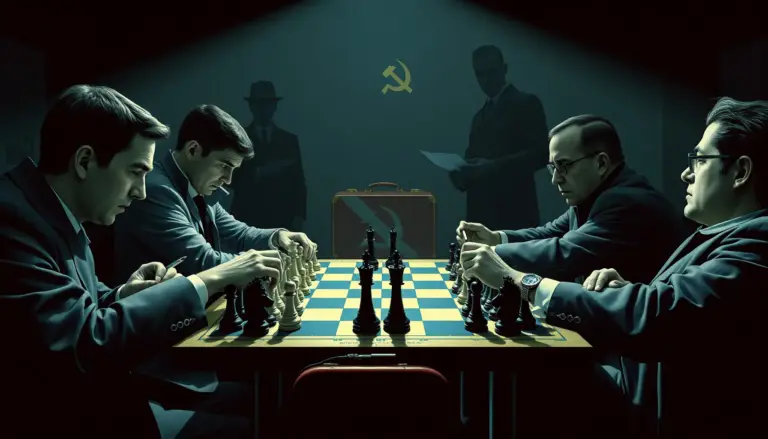
From recording sessions to dressing rooms, Chess has been a silent but constant companion in the lives of many musicians.. Artists like David Bowie, Jay-Z, Sting or Madonna have not only dominated the charts, but also the boards 64 casillas. What unites two disciplines apparently as different as music and chess?? Beyond chance, there is a deep connection between the two: strategic creativity, mental discipline and the ability to anticipate the movement of others. This article explores why iconic music figures have found chess to be more than just a hobby., but a tool to hone your art, make decisions under pressure and even inspire your compositions. From jazz to hip-hop, going through rock and electronics, chess has left its mark on musical culture, revealing that, in the end, both musicians and grandmasters play by the same rules: imagination, patience and audacity.
Chess as mental training for creativity
Music and chess share a fundamental basis: both are arts that require a combination of logic and creativity. for a musician, composing a song or improvising a solo requires thinking several steps ahead, just like a chess player anticipates his opponent's moves. This ability is not innate, but he trains, and chess has proven to be an effective method to develop it.
Studies in neuroscience, like those made by London Institute of Cognitive Neuroscience, have confirmed that playing chess activates areas of the brain related to planning, working memory and problem solving. These same areas are crucial for musicians, especially in genres like jazz or hip-hop, where improvisation is key. For example, Saxophonist John Coltrane was an avid chess player and attributed part of his ability to develop complex solos to constant practice of the game.. In an interview of 1960, Coltrane stated: *”Chess teaches me to see patterns where others only see chaos. The same thing happens with music: if you can't anticipate the next chord, you are lost”*.
Besides, chess encourages tolerance for ambiguity, an essential quality for artists. in music, like in chess, there is not always a correct answer; sometimes, the best move is the one that opens new possibilities. This mentality is evident in the work of David Bowie, who incorporated non-linear structures in albums like Outside (1995), inspired by chess games where apparent chaos hides an underlying order. Bowie, who even played games with the British champion Nigel Short, I compared the creative process to a game: *”Writing a song is like moving a piece: you don't know how the public will react, Just like you don't know how your opponent will respond.. But if you trust your instinct, something magical can arise”*.
Discipline and concentration: board lessons for stage
Discipline is another bridge between chess and music. Both require hours of constant practice., attention to detail and the ability to stay focused under pressure. for a musician, a live performance is like a chess game in real time: a mistake can cost you dearly, but prior preparation makes the difference.
Rapper Jay-Z is a paradigmatic example of how chess can shape an artist's mentality. In his autobiography Decoded (2010), Jay-Z reveals he learned to play chess on the streets of Brooklyn as a way to understand strategy and patience. *”Chess taught me that you can't win if you only think about the next move. You have to see the full game, just like in music: a song is not just a verse, It is a story that is built from the first beat”*. This philosophy is reflected in his album The Blueprint (2001), where each track is carefully calculated to create a coherent narrative arc, something he compares to a well-executed chess opening.
The concentration required by chess is also transferable to the stage. Sting, another passionate about the game, has mentioned in interviews that playing live requires the same mindfulness than a high level game. *”When you're on stage, you can't afford distractions. Chess taught me to block out external noise and focus on what is essential: the music, the rhythm, connection with the public. It's like being in checkmate: or you react clearly, or you lose”*. This ability to remain calm under pressure is what separates great musicians from good ones..
Even in more intuitive genres, like flamenco, chess has left its mark. Guitarist Paco de Lucía, considered one of the best in history, He was a regular player and claimed that the game helped him *”train the mind to listen beyond the notes”*. In an interview of 1995, explained: *”Flamenco is pure improvisation, but also structure. Chess teaches me to balance both: to let myself be carried away by the elf, but knowing that each measure has its place, like every piece on the board”*.
Chess as a metaphor for life and music
Beyond technical skills, Chess has served many musicians as a powerful metaphor for life, competition and creativity. In a world where the music industry can be as ruthless as a chess tournament, Understanding the rules of the game—and when to break them—is essential to survival..
Bob Dylan, although he was not a regular player, He used chess as a symbol in his work. in the song When I Paint My Masterpiece (1971), Dylan sings: *”Oh, the streets of Rome are filled with rubble / Ancient footprints are everywhere / You can almost think that you’re seein’ double / On a cold, dark night on the Spanish Stairs”*. The letter, loaded with images of strategy and movement, evokes the feeling of a chess game where every decision has consequences. Dylan, Known for his ability to reinvent himself, I saw the musical career as a board where *”every album is a gambit: you sacrifice something to gain something greater”*.
in hip-hop, chess has become a symbol of power and strategy. Artists like Wu-Tang Clan, whose leader RZA is an obsessive gamer, They have incorporated references to the game in their lyrics. On the topic Da Mystery of Chessboxin’ (1993), the group compares rap to a game: *”I’m the rap version of the chess game / Checkmate, now what’s your next move?”*. For RZA, chess is not just a game, but a tool to understand the dynamics of the music industry. *”in hip-hop, like in chess, you have to know when to attack and when to retreat. If you stay in check, you lose. If you stay in the same style, also”*, declared in an interview for The New Yorker in 2015.
This metaphor also extends to collaboration. In 2018, jazz pianist Brad Mehldau and chess grandmaster Garry Kasparov participated in a public dialogue titled Music and Chess: Parallels in Creativity, where they explored how both worlds feed each other. Mehldau argued that *”chess is like a musical composition: you start with a topic (the opening), you develop it (the middle game) and you reach a climax (the end). The difference is that, in music, the climax can be emotional; in chess, It stands to reason”*. Kasparov, for his part, added that *”creativity in chess is no different from that in music: both require breaking established rules to create something new”*.
Inspiration and composition: when chess becomes music
For some musicians, Chess is not only a training tool or a metaphor, but a direct source of inspiration. The structure of the game, Its patterns and even its legends have given rise to musical works that capture the essence of a game.
One of the most notable examples is the Chess Symphony (1928) by the Russian composer Sergei Prokofiev, written to celebrate the first world chess championship organized in the USSR. Prokofiev, who was an amateur player, translated the game's movements into music, assigning melodic themes to each piece and creating a sound dialogue between the two sides. The work, although little known, is a testimony of how chess can become a musical language.
in the rock, the British band Queen also explored this connection. Freddie Mercury, a chess enthusiast, incorporated references to the game in songs like One Vision (1985), where the letter *”One man, one goal, one mission”* evokes the determination of a player in a decisive game. Brian May, guitarist of the band, has mentioned that Mercury viewed songwriting as *”a battle of ideas, where each chord is a strategic movement”*.
In the contemporary sphere, electronic producer Aphex Twin has taken this idea to the extreme. in your album Drukqs (2001), included a track titled Avril 14th, whose minimalist and repetitive structure has been compared to the rhythm of a chess game in its initial phase. Richard D. James, the brain behind Aphex Twin, has stated that *”electronic music and chess share an obsession with patterns. Both are precision games, where a small change can alter the entire result”*.
But perhaps the most fascinating case is that of the composer John Cage, who in 1968 believe Reunion, a work where the music is generated from a game of chess. Cage and the artist Marcel Duchamp (also a passionate chess player) They designed a board with sensors that activated sounds every time a piece was moved. The work, performed live, showed that chess could be both a game and a score. Cage explained: *”Chance is part of the music, just like in chess. You don't know what your opponent will do, just like you don't know what note will emerge from the silence. But there's the beauty: in uncertainty”*.
These examples show that chess is not just a hobby for musicians, but a universal language that transcends barriers between disciplines. Whether as mental training, metaphor of life or source of inspiration, The game of kings has found a permanent place in the heart of music.
The relationship between musicians and chess is no coincidence, but the result of a natural affinity between two arts that, in the background, they pursue the same: create beauty from rules, order from chaos and emotion from strategy. From improvised games in the dressing rooms to symphonic works inspired by the game, Chess has proven to be much more than just entertainment for artists. It's a school of thought, a metaphor for life and, in some cases, the trigger for some of the most innovative creations in modern music.
In the end, both musicians and chess players are architects of dreams. Some build with notes; others, with movements. But they both know that, on the board or on the stage, True magic happens when logic and emotion meet. Maybe that's why figures like Bowie, Jay-Z or Coltrane found chess not just a game, but a mirror of his own genius. And it is that, after all, What is a great song but a game won against time, silence and expectations?