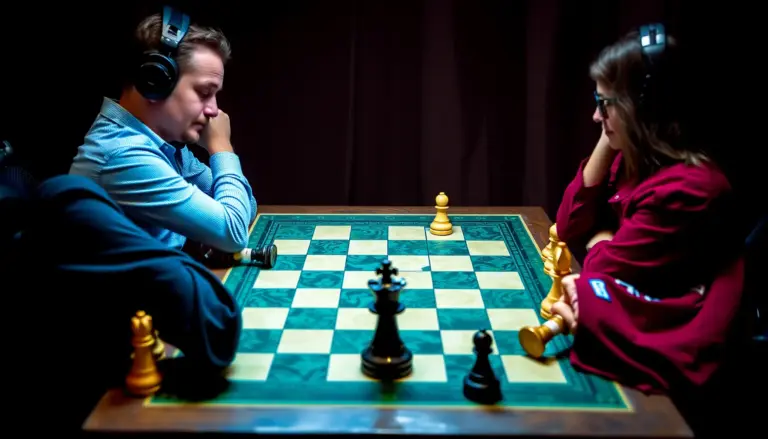
Imagine for a moment that time stops. There are no clocks that mark the passing of the seconds, No notifications that interrupt your concentration. There is only the board, the pieces and the feeling that each movement is a natural extension of your thinking. This state, where the mind flows effortlessly and pleasure replaces stress, is what psychologists call flow. in chess, This phenomenon is no exception., but an almost mystical experience that millions of players describe as addictive. But, What is behind this loss of temporal notion?? Is chess a portal to pure concentration or simply an escape from reality?
Chess as a springboard to flow: beyond entertainment
The concept of flow, acuñado por el psycóloge Mihály Csíkszentmihályi, describes a state of total immersion in an activity where challenge and skill are perfectly balanced. in chess, this balance is palpable. A beginning player can feel it when solving his first tactical problem, while a great master experiences it in games where each movement seems to arise from an instinct honed by years of practice. But, Why is chess so likely to induce this state??
The answer lies in its structure. The board is a closed system with clear rules, but infinite in possibilities. Each game is a unique puzzle where the mind must constantly adapt, no room for monotony. Unlike other games, chess requires a active concentration, where the player not only reacts, but anticipates, calculate and create. This dynamic activates the same neural networks that light up during meditation or complex problem solving., How do studies explain Ajedrez and mindfulness.
Besides, chess offers immediate feedback. Every movement of the rival is a stimulus that forces us to rethink the strategy, keeping the mind in a state of creative alert. This constant interaction between action and reaction is what makes time seem to distort.. It is no coincidence that many players report how a five-hour game feels like twenty minutes..
The paradox of time: why does chess distort it?
The altered perception of time during a chess game is not a subjective phenomenon, but a neurobiological process. Research in neuroscience has shown that, When the brain enters a state of flow, activity in the prefrontal cortex—responsible for temporal notion—decreases. instead, areas related to creativity and decision making are activated, like the nucleus accumbens, associated with reward and pleasure.
But there is a crucial nuance: he flow in chess it is not a passive state. Requires a level of challenge that slightly exceeds the player's abilities. If the game is too easy, boredom arises; if it's too difficult, anxiety. This balance is what makes chess so effective at inducing flow, even in therapeutic contexts, as detailed in the article on therapeutic chess for young people with depression.
A paradigmatic example is that of the players of blitz o quick matches. In these formats, where time is scarce, he flow intensifies. The pressure of the clock forces the mind to operate in an almost automatic mode, where intuition replaces exhaustive calculation. However, This state can also be dangerous: the addiction to flow in rapid chess has led some players to neglect other areas of their life, looking for that feeling of immersion again and again.
Chess as a refuge: when he flow becomes an escape
For many, chess is not just a game, but a refuge. In a hyperconnected world, where attention is constantly fragmented, the dashboard offers a space of silence and control. This aspect is especially relevant in crisis contexts., such as wars or forced displacement, where chess has become a tool of resilience. An emblematic case is that of the refugees who find a temporary escape in chess of their realities.
He flow In chess it also acts as an antidote to anxiety. By immersing yourself in the game, the mind disconnects from external concerns and focuses on the present. This quality has made it a complementary practice in psychological therapies., especially for people with anxiety disorders or post-traumatic stress disorder. The feeling of accomplishment when solving a tactical problem or winning a game releases dopamine, reinforcing the cycle of pleasure and concentration.
However, this shelter can become a trap. some players, especially those with perfectionist profiles, they fall into the obsession of reaching that state of flow constantly. The search for the perfect game or immaculate victory can generate frustration, turning pleasure into a source of stress. This is where chess reveals its duality: It is both a balm and a mirror of our own limitations.
He flow in the digital age: new paradigm or mirage?
The arrival of platforms like Lichess or Chess.com has democratized access to chess, but it has also transformed the experience of flow. Playing online allows you to immerse yourself in games at any time, but the ephemeral nature of these interactions can dilute the depth of the state of concentration. The temptation to abandon a game at the first mistake or the ease of restarting a new game interrupt the natural cycle of flow, that requires time and patience to develop.
Nevertheless, technology has also opened new doors. Tools such as analysis engines or tactics banks allow players to train more efficiently, striking that balance between challenge and skill more easily. Besides, The online community has created spaces where the flow is shared, such as in live broadcasts where viewers learn while watching great masters in action. This phenomenon has been key in the resurgence of chess as a cultural phenomenon., as analyzed in the impact of the internet on the globalization of chess.
But the question remains: Can digital chess offer the same quality of flow than a face-to-face game? The answer is not simple. While online play sacrifices the human connection and atmosphere of a physical tournament, gains accessibility and diversity of opponents. For many, especially those in rural areas or with mobility limitations, Digital chess is the only way to experience that state of immersion.
He flow as a growth tool: board lessons for life
Beyond immediate pleasure, he flow Chess teaches valuable lessons applicable to everyday life. The first is the importance of focusing on the process, not in the result. In a game, he flow arises when the player concentrates on each movement, without obsessing about checkmate. This mentality is transferable to any field: from work to personal relationships, where obsession with success often clouds enjoyment of the journey.
Another lesson is resilience. He flow it is not achieved without effort. Requires practice, patience and the ability to learn from mistakes. in chess, Every defeat is an opportunity to adjust strategy and improve. This growth mindset is essential in a world where immediacy and instant gratification dominate the culture..
Finally, chess teaches how to manage uncertainty. on the board, like in life, there are no guarantees. A player can have an overwhelming advantage and lose in a single move. Learning to navigate this uncertainty without falling into anxiety is an invaluable skill., and the flow It is the state that allows you to do it with serenity. To delve deeper into how chess shapes the mind, you can explore this analysis on its cognitive benefits.
chess, in essence, It's a microcosm of life. He flow What we experience when playing is not just a loss of track of time, but an invitation to inhabit the present fully. In a world where distraction is the norm, the board reminds us that pure concentration is not a luxury, but a necessity. The next time you sit in front of 64 casillas, don't just look to win. Look for that moment where time stops, where every movement is a dance between the mind and the board. That's the real prize.
And you, Have you ever felt that state of flow when playing chess? What other activities have led you to lose track of time for pure pleasure??