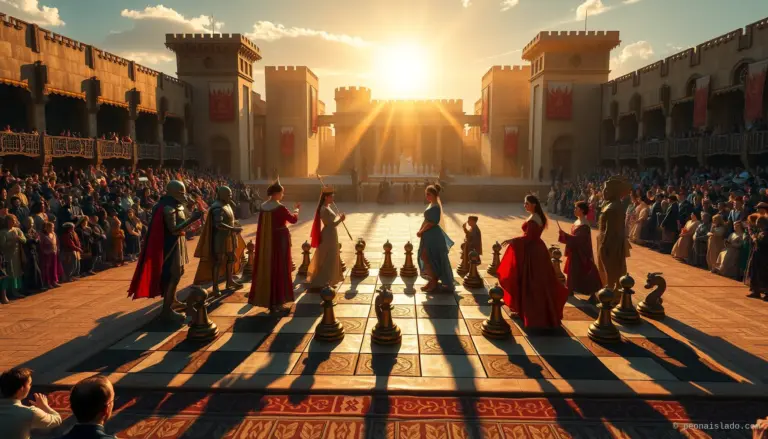
Imagine a board where each movement is a brushstroke, Every sacrifice a metaphor and every checkmate a masterpiece. Artistic compositions in chess are not simple calculation exercises; They are the intersection between the purest logic and the most overflowing creativity., a space where the game transcends its competitive nature to become a universal language. From intuition-defying double mate problems to immortal games that have inspired generations, artistic chess reveals an uncomfortable truth: the board is not just a battlefield, but a blank canvas where the human mind explores the limits of the possible. What's behind these creations?? How do you manage to combine beauty and precision in 64 casillas? Y, above all, Why do they continue to fascinate players and artists alike??
Chess as art: when strategy becomes poetry
Artistic chess is not a byproduct of the game, but one of its highest expressions. Unlike a conventional game, where the objective is to beat the rival, artistic compositions seek to convey an idea, evoke an emotion or even tell a story. Let's take as an example The Immortal, the game played in 1851 between Adolf Anderssen and Lionel Kieseritzky. Beyond its historical value—it was one of the first games to be analyzed as a work of art—, what makes it eternal is its narrative structure: one sacrifice after another, a relentless attack that culminates with the most spectacular checkmate in romantic chess. It is no coincidence that this game has inspired writers like Stefan Zweig or filmmakers like Stanley Kubrick., who included it in 2001: A space odyssey as a symbol of human intelligence.
But the art of chess is not limited to historical games.. Los chess problems —especially composition ones— are the equivalent of haikus on the board: brief, intense and loaded with meaning. A well-constructed problem not only solves a tactical challenge, but he does it with elegance, like a poem that finds the right word at the right moment. Russian composer Vladimir Korolkov, For example, created problems where the pieces seem to dance on the board, defying the laws of chess physics. His work Excelsior, where a pawn advances from its initial square to crown on the eighth rank, It is a study in perseverance and transformation, a visual metaphor for how the seemingly insignificant can become something great.
What distinguishes an artistic composition from a simple tactical exercise? The answer is in the media economy. in art, less is more. A mating problem in three that could be solved with four pieces, but that the composer achieves with only two, not only is it more beautiful, but it requires a higher level of creativity. This search for formal perfection is what connects chess with other artistic disciplines., like music or painting. As the great teacher and composer Pal Benko said: “A chess problem is like a symphony: each note—or in this case, each movement—must be in its exact place for the whole to work”.
The chess composition: a laboratory of ideas
Behind each artistic composition there is a creation process that goes beyond mere calculation. Composers of chess problems—like poets or musical composers—work with self-imposed constraints to force creativity.. For example, some limit themselves to using only white pieces, others prohibit the use of pawns, and there are those who demand that the mate be achieved with a unique and surprising movement. These arbitrary rules are not whims; They are the equivalent of poetic forms such as the sonnet or haiku, that force the artist to explore innovative solutions within a rigid framework.
A paradigmatic case is that of the help-mate problems, where black collaborates with white to receive checkmate. Prima facie, This seems to contradict the essence of chess., But that is precisely where his genius lies.: by eliminating conflict, the composer can focus on the beauty of the sequence. The most famous help-mate problem, created by the German Friedrich Amelung in 1900, shows how a black pawn and a white bishop can coordinate to mate the black king in just two moves. The solution is so unexpected that it seems like a magic trick, but in reality it is the result of a mind that sees the board as a space of infinite possibilities.
This experimental mindset has also given rise to chess variants that challenge conventions.. He alternative chess, For example, includes modalities such as cylindrical chess (where the board wraps around itself) or the Alice's chess (where the pieces can “teleport” through mirrors). These variants are not only fun, but rather they force the player to rethink basic concepts such as space and time on the board.. Son, in essence, lateral thinking exercises applied to chess, and they show that even a game with ancient rules can be reinvented.
Chess in culture: when the board transcends the game
If artistic chess is a language, so its grammar has infiltrated almost all forms of cultural expression. From literature to cinema, passing through painting and music, the board 64 Casillas has served as a metaphor for life, the power, war and even destiny. in the novel The chess player the Stefan Zweig, the protagonist, Dr. B., uses chess as a tool of mental resistance during his imprisonment by the Nazis. The game he plays against himself in his cell is not just a hobby, but an act of rebellion against oppression, a way to keep your humanity alive in inhumane conditions. This idea of chess as a psychological refuge also appears in works such as The defense de Vladimir Nabokov, where the protagonist, Luzhin, he finds in the game an order that real life denies him.
in the cinema, chess has been used to represent intellectual conflicts, political tensions and even the clash between man and machine. The climactic scene of The seventh seal (1957), where the knight Antonius Block plays a game against Death, It is one of the most iconic representations of chess as a symbol of the human struggle against the inevitable.. More recently, the series The Queen’s Gambit not only revived global interest in chess, but also explored themes such as genius, addiction and loneliness through gambling. The fascinating thing is that, in all these works, chess is not a simple decoration, but one more character, with your own voice and your own story.
This connection between chess and art is not coincidental. Both require a combination of technique, creativity and discipline, and both offer a way of understanding the world. As Marcel Duchamp said, the artist who abandoned art to dedicate himself to chess: “Chess is an art form, and each game is a work of art in itself”. Duchamp, in fact, he came to compose chess problems and design boards, demonstrating that the border between game and art is more permeable than it seems. Hoy, His legacy lives on in initiatives such as chess museums, where historical games, Antique pieces and artistic compositions are displayed as works of art.
The future of artistic chess: between tradition and innovation
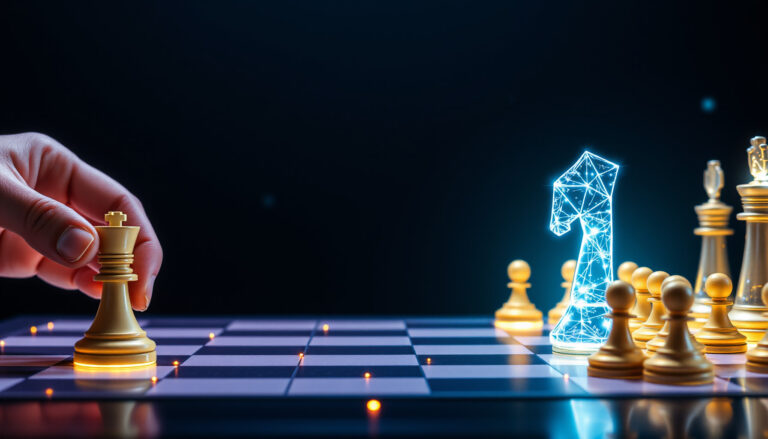
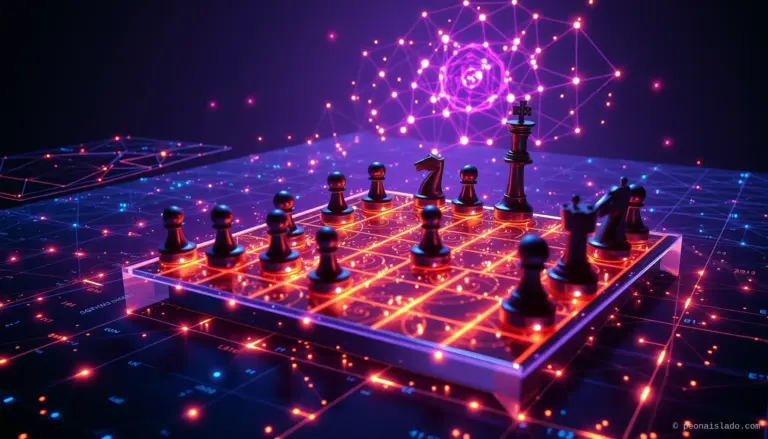
In the era of artificial intelligence and chess engines, one might think that artistic compositions have lost relevance. After all, What can a mate-in-three problem do when an algorithm like Stockfish can calculate millions of positions per second?? However, It is precisely in this context where artistic chess takes on a new meaning.. If machines dominate the calculation, We humans can focus on what they cannot replicate.: creativity, emotion and beauty.
In fact, AI has opened up new possibilities for chess composition. Programs like Chesthetica, developed by researcher Azlan Iqbal, They are capable of generating chess problems with a high degree of originality, combining classic patterns with unexpected solutions. These systems do not replace the human composer, but they act as collaborators, suggesting ideas that can then be refined by the creative mind. It is a perfect example of how technology can enrich art., instead of destroying it.
But the real challenge for artistic chess is not technological., but cultural. In a world obsessed with speed and immediate results, Who has time to appreciate the beauty of a chess problem?? The answer could be in education. Countries like Armenia have shown that chess can be a powerful pedagogical tool, not only to develop cognitive skills, but also to encourage creativity and critical thinking. If more schools incorporated chess composition into their programs, not only would they be developing better players, but also more open and sensitive minds to art.
Besides, artistic chess plays a crucial role in preserving the human essence of the game. While quick games and online chess prioritize efficiency and victory at any cost, artistic compositions remind us that the board can also be a space for exploration, of pure play and personal expression. In a world where chess has become a mass sport, chess art acts as a counterweight, reminding us that, in the end, the important thing is not just to win, but how to play.
Conclusion: the board as a mirror of the soul
Artistic compositions in chess are much more than exercises in ingenuity; They are a testament to the human ability to find beauty in logic, poetry in strategy and meaning in the seemingly trivial. From mate-in-deuce problems that challenge our intuition to immortal games that have inspired artists and writers., artistic chess invites us to see the board not as a battlefield, but as a space of infinite creation.
In a world increasingly dominated by technology, artistic chess offers us a valuable lesson: Intelligence is not measured only by the ability to calculate, but for the ability to imagine. As composer and grandmaster Genrikh Kasparyan said: “A chess problem is like a dream: the more strange, most beautiful”. Maybe, in the end, the true checkmate is not the one we win on the board, but what we achieve in our own mind, when we discovered that chess is not just a game, but an art form.
If this article has awakened your curiosity about chess beyond the competitive, We invite you to explore the links between chess and culture, or to immerse yourself in the world of historical moments of chess, where each game is a lesson in strategy and creativity. The board is ready; All you need to do is turn it into your own canvas..