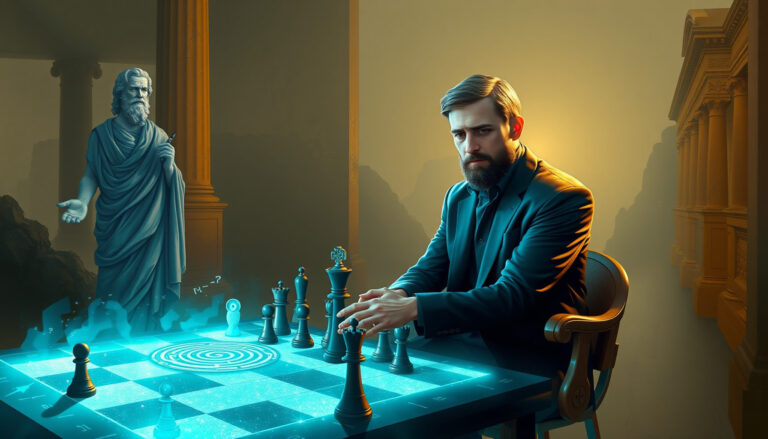
Chess is a battlefield where the human mind faces not only its rival, but to herself. Every move on the board is a reflection of decisions made under pressure, expectations and, above all, of the psychological errors that even the strongest players commit. These failures are not simple tactical oversights; They are chinks in the mental armor that can turn a won game into a humiliating defeat.. Why a great teacher, capable of calculating variants with surgical precision, can fall into traps that a beginner would avoid? The answer is not in technical knowledge, but in the psychology that governs each decision.
In this article, We will explore the most common psychological errors that plague chess players, from overconfidence to analysis paralysis, and how these mental habits can sabotage performance even at the highest levels. Why, in the end, Chess is not just a game of pieces and rules, but a mirror of the human mind in its struggle for control.
The illusion of control: when confidence turns to arrogance
One of the most devastating psychological errors in chess is illusion of control, a phenomenon in which the player overestimates his ability to dominate the game. This cognitive bias manifests itself when a chess player, after a series of successful moves, assume you have the situation under control and relax your attention. The history of chess is full of examples where great masters, as Magnus Carlsen, have fallen into this trap, underestimating rivals who, in appearance, were inferior.
The illusion of control not only affects the perception of risk, but also distorts the assessment of threats. A player who believes he has the game won may ignore clear signs of danger, such as an unexpected counterattack or a tactical error by the opponent. This overconfidence is fueled by availability heuristic, a mental shortcut that makes us judge the probability of an event based on recent examples. If a chess player has won several games in a row, Your brain tends to underestimate the possibility of defeat, even when dashboard signs indicate otherwise.
To counteract this error, It is crucial to maintain a growth mindset, a concept that is explored in depth in the article on winning mentality in chess. Instead of assuming that control is absolute, Players must adopt an attitude of strategic humility, where each movement is analyzed with the same rigor, regardless of the state of the game.
Paralysis by analysis: When thinking too much is worse than not thinking
Chess is a decision game, But there is a point at which the search for the perfect play becomes an obstacle. The paralysis by analysis occurs when a player is immersed in a labyrinth of variants, losing sight of the big picture. This error is especially common in players with a positional style., who tend to prioritize precision over intuition. However, even the great tactical masters, as Rudolf Spielmann, have succumbed to this phenomenon, wasting valuable time calculating plays that, in retrospect, are irrelevant.
Paralysis by analysis not only consumes time, but it also generates anxiety. When a player becomes obsessed with finding the move “perfect”, your brain goes into a state of hypervigilance, where each option seems equally valid or dangerous. This state of mind is similar to imposter syndrome, where constant doubt paralyzes action. To avoid it, It is essential to develop a hierarchy of priorities during the game: first, identify immediate threats; second, evaluate tactical opportunities; and third, consider long-term positional plays.
A useful tool to combat this error is the two minute rule, which consists of limiting the reflection time for non-critical movements. If after two minutes no clear play has been found, It is better to trust your intuition and move forward. This technique, combined with concentration techniques used by the great masters, can help maintain the flow of the game without falling into the trap of over-analysis.
Confirmation bias: when you only see what you want to see
He confirmation bias It is one of the most insidious psychological errors in chess. This bias leads us to look for information that confirms our previous beliefs., ignoring contradicting evidence. In the context of chess, This means that a player, once you have formed an opinion on the position, tends to interpret the opponent's movements in a way that reinforces his initial evaluation, even when the board suggests otherwise.
A classic example of this error occurred in the game between Garry Kasparov and Anatoly Karpov at the World Championship 1985. Kasparov, convinced that his kingside attack was unstoppable, ignored signs that Karpov was preparing a counterattack in the center. The result was a defeat that Kasparov later admitted he could have avoided if he had been more objective in his assessment..
Confirmation bias is especially dangerous because it feeds on emotional availability. When a player is emotionally invested in a strategy, your brain selectively filters information, highlighting data that supports your plan and minimizing data that questions it. To counteract this error, It is useful to adopt the perspective of a devil's advocate, that is to say, actively seek arguments against one's own evaluation. Questions like “What would happen if my rival does X?” o “What threat am I not seeing??” can help break this bias and open your mind to new possibilities.
The anchoring effect: when the first move determines the entire game
He anchoring effect is a psychological error that occurs when a player clings to an initial idea, even when board circumstances have changed. This phenomenon is common in openings, where a chess player can become obsessed with a specific variant, ignoring that the opponent has diverted the game into unknown territory. The anchoring effect not only limits strategic flexibility, but can also lead to tactical errors, since the player continues to act as if the position were the one he had imagined, not the one that really exists.
An emblematic case of this error is observed in the game between Bobby Fischer y Boris Spassky in 1972. Fischer, known for its meticulous preparation, fell into the pinning effect during game 6, where he insisted on an opening line that Spassky had prepared to counter. Instead of adapting to the new dynamics of the game, Fischer persisted in his initial plan, what the game cost him and, temporarily, the lead in the match.
To avoid the anchoring effect, It is crucial to develop a adaptive mindset. This means being willing to abandon a strategy if the board demands it., even if it means admitting that the initial plan was wrong. A useful technique is constant review of position, where the player periodically asks himself: “Is my initial evaluation still valid?” o “What has changed in recent movements?”. This practice, combined with a focus on lateral thinking, can help maintain the mental flexibility necessary to adapt to opponent's surprises.
Loss aversion: when the fear of losing is worse than defeat itself
The loss aversion It is a psychological error deeply rooted in human nature. in chess, This bias manifests itself when a player, instead of looking for the best move, opt for the most option “segura” to avoid risks. This behavior is especially common in balanced positions, where a player with an advantage can settle for a draw rather than risk a loss. However, loss aversion can be counterproductive, as it often leads to passive decisions that allow the opponent to regain the initiative.
A notable example of this error occurred in the game between Ding Liren and Fabiano Caruana in the Candidates Tournament 2022. Ding, with a slight positional advantage, opted for a series of conservative moves that allowed Caruana to equalize the game. Instead of pushing to maintain the advantage, Ding settled for a draw, a decision that many analysts attributed to their aversion to risk in a high-level tournament.
Loss aversion is closely related to status quo bias, that makes us prefer to maintain the current situation instead of changing it, even when the change could be beneficial. To overcome this error, It is useful to remember that chess is a game of calculated risks. Instead of avoiding defeat at all costs, Players must focus on maximizing their opportunities, even if it means taking certain risks. An effective strategy is rule of 70%, which consists of choosing the move that has at least one 70% probability of success, instead of opting for the option “segura” which offers no advantage.
Conclusion: the board as a mirror of the mind
Chess is much more than a strategy game; It is a laboratory where the limits of human psychology are tested.. The errors we have explored—the illusion of control, paralysis by analysis, confirmation bias, the anchoring effect and loss aversion—are not simple technical failures, but manifestations of how our mind processes information under pressure. These errors do not distinguish between beginners and great masters; we are all vulnerable to them, regardless of our level.
However, The real challenge is not to avoid these errors completely—something impossible., but learn to recognize and manage them. As noted in the article on how to avoid tilt in chess, The key is to develop mental habits that allow us to maintain clarity even in the most critical moments.. This includes practicing constructive self-criticism, cultivate strategic flexibility and, above all, accept that error is an inherent part of learning.
In the end, Chess teaches us that the most important battle is not fought against the opponent, but against ourselves. Each game is an opportunity to observe how our mind reacts to uncertainty, pressure and failure. Y, if we are able to learn from these mistakes, we will not only improve our game, but we will also develop greater mental resilience that will transcend the board. Why, As the great Emmanuel Lasker said, “in chess, like in life, the most dangerous adversary is oneself”.