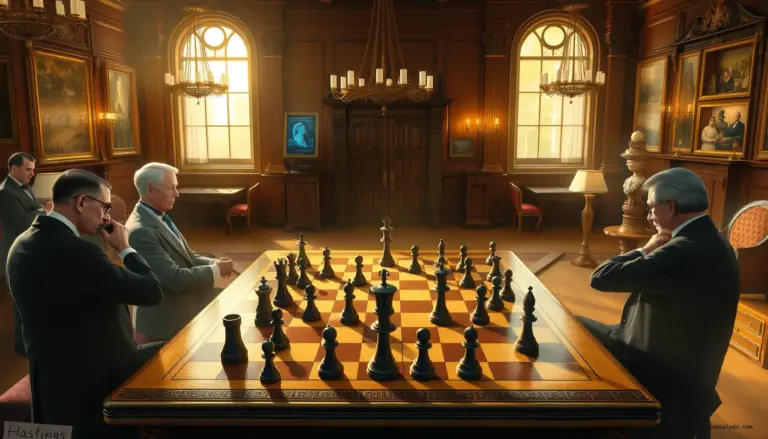
Chess is much more than just a strategy game.. Since its invention in India more than 1.500 years, has fascinated millions of people around the world, becoming an obsession for some and an educational tool for others. But, what's behind its hypnotic power? Why so many people, from beginners to grandmasters, fall under its spell and, in some cases, develop an addiction?
Science has begun to unravel the mysteries of this ancient game, revealing how it activates key regions of the brain, stimulates the production of dopamine and generates a feeling of reward similar to that of other addictions. However, unlike traditional addictions, Chess also offers cognitive benefits, emotional and social. In this article, We will explore the neurological and psychological mechanisms that make chess such an addictive activity., analyzing both its risks and its advantages. Is chess really an addiction or just a passion that, like everything in excess, can become dangerous?
The brain in check: How chess activates reward circuits
When a person plays chess, Your brain undergoes a series of neurochemical processes that explain its addictive power.. Neuroimaging studies, like those made by Max Planck Institute for Human Development, have shown that chess activates the nucleus accumbens, a region associated with reward and pleasure. This area frees dopamine, a key neurotransmitter in motivation and sense of achievement.
But chess not only stimulates dopamine. It also launches the prefrontal cortex, responsible for logical thinking and decision making, and the hippocampus, linked to memory and learning. This combination of brain activation is similar to that seen in addictions such as video games or gambling., but with a crucial difference: chess does not depend on external factors such as chance, but of the skill and effort of the player.
A study published in the journal Frontiers in Psychology (2019) found that chess players experience an increase in dopamine levels when anticipating a winning move, which reinforces the behavior of continuing to play. This positive reinforcement mechanism is the same one that underlies addictions., but in the case of chess, is linked to an intellectual challenge that can be beneficial if managed properly.
The chess paradox: addiction vs. cognitive improvement
Although chess can generate addictive patterns, It is also one of the most recommended activities to improve cognition. The University of Memphis conducted a study in 2011 which showed that children who played chess regularly improved their IQ, your ability to concentrate and your working memory. These benefits are not limited to the youngest: a study of Albert Einstein College of Medicine (2019) found that older adults who played chess reduced by 74% the risk of developing dementia.
So, How to reconcile these benefits with the risk of addiction? The key is in balance. chess, like any activity that stimulates dopamine, can become problematic when it becomes a avoidance behavior. Some players use it to escape personal problems, stress or anxiety, falling into a cycle of compulsive gambling. However, when practiced in moderation and with a clear purpose (such as learning or socialization), Its effects are overwhelmingly positive.
A report of the World Health Organization (OMS) in 2020 highlighted that chess can be a valuable tool for mental health, as long as it is not used as an escape mechanism. The difference between a healthy passion and an addiction lies in the awareness and the self control. Play to improve, competing or enjoying is beneficial; playing to escape reality can be dangerous.
The dark side of the board: when chess becomes an obsession
Not all cases of chess addiction are the same, but there are worrying patterns. He chess overtraining syndrome, described for the first time in a study of the Oxford University (2017), refers to players who spend more than 8 hours per day to play, neglecting your social life, work and even your physical health. These cases are usually accompanied by anxiety about losing, insomnia and, in extreme situations, depression.
A famous example is that of the great teacher Bobby Fischer, whose obsession with chess led him to isolate himself from the world and develop serious psychological problems. Fischer is not the only one: many professional players admit to having suffered episodes of burnout or mental exhaustion due to constant pressure to improve. The difference between a fan and an addict lies in the loss of control. While the first can leave the board whenever he wants, the second feels an urgent need to continue playing, even when you know you should stop.
The American Psychiatric Association (WHAT) does not officially recognize chess addiction as a disorder, but some mental health experts compare it to video game addiction, included in the Diagnostic and Statistical Manual of Mental Disorders (DSM-5). Criteria for identifying a chess addiction include:
- Loss of interest in other activities.
- Irritability or anxiety when you can't play.
- Denial of problems caused by excessive gambling.
- Using chess as an escape from emotional problems.
Recognizing these signs is the first step to seeking help. Therapies like cognitive-behavioral have been shown to be effective in treating behavioral addictions, helping gamers regain control over their time and emotions.
Chess in the digital age: new risks or new opportunities?
The arrival of platforms like Chess.com y Lichess has democratized access to chess, but it has also introduced new challenges. The possibility of playing online 24 hours of the day, with opponents from all over the world, the risk of addiction has increased. A study of the Stanford University (2021) found that players who use these platforms have a 30% more likely to develop compulsive gambling patterns than those who gamble in person.
However, Technology also offers tools to combat addiction. Some platforms have implemented game time limits and reminders to take breaks. Besides, the online chess community can be a supportive space, where players share experiences and strategies to maintain a healthy balance.
Another positive aspect is the rise of educational chess. Programs like Chess in Schools have shown that teaching chess in classrooms improves academic performance and fosters skills such as patience and resilience. In this context, chess is not an addiction, but a tool for personal growth.
The key is to take advantage of the benefits of technology without falling into its traps.. Set schedules, play with a clear purpose (how to improve or socialize) and seeking help when the game becomes obsessive are effective strategies to enjoy chess without it becoming a problem.
Conclusions: Is chess an addiction or a healthy passion?
chess, like any activity that stimulates the brain and generates pleasure, has the potential to become an addiction. However, This possibility should not overshadow its innumerable benefits. Science has shown that chess improves cognition, reduces the risk of neurodegenerative diseases and promotes social and emotional skills. The problem is not the game itself, but the way we approach it.
The difference between an addiction and a healthy passion lies in the control. Play chess to challenge the mind, learning or socializing is positive; Doing it to escape reality or as the only source of pleasure can be dangerous. Recognizing the signs of an emerging addiction and seeking help when necessary is essential to enjoying chess without it becoming a burden..
Ultimately, chess is a reflection of life: a strategy game, patience and balance. As the great teacher said Garry Kasparov: “Chess is the gymnastics of the mind”. But, like in any gym, excess can lead to exhaustion. The key is to find the middle point, where the game remains a pleasure and not an obsession.
If you feel like chess is dominating your life, don't hesitate to seek support. Chess addiction, although it is not as well known as others, It's real and treatable.. But if you play it with moderation and purpose, It can be one of the most enriching activities that exist.