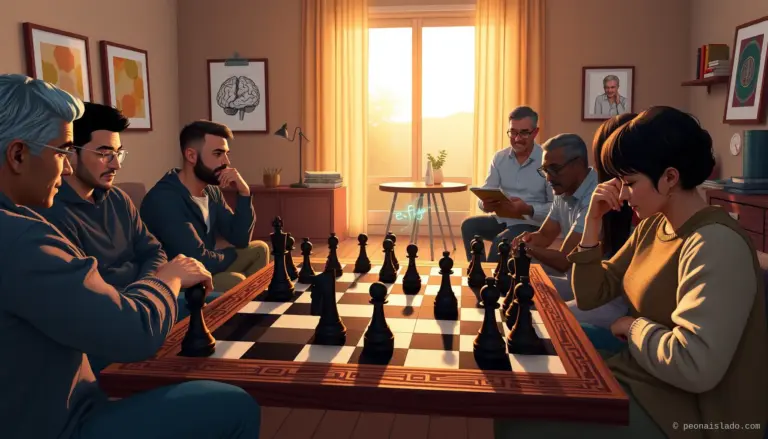
Chess in the parks of Medellín is not just a game; It is an act of cultural resistance, an exercise in collective strategy and a bridge between generations. Among the greenery of the Culturparques and the shadows of the ancient trees, The board becomes a stage where the theory of isolated pawn —that vulnerable piece but full of potential—takes on a deeper meaning. It is not just about calculating variants in a rook ending, but to understand how a community, like a pawn in the center of the board, can transform your environment despite adversity. Here, Chess transcends sport to become a metaphor for life itself, where every movement is a decision that shapes the future.
Medellín, a city that has known how to reinvent itself from the ashes of violence, found in chess a tool to rebuild social fabric. The parks, traditionally meeting and recreation spaces, have become open-air classrooms where children, young people and adults learn not only to move pieces, but to think critically, to anticipate consequences and value patience. This phenomenon is not coincidental: responds to a deliberate strategy of democratization of the game, driven by initiatives such as Chess Immersion Rooms and programs that seek to take the board to the most vulnerable corners of the city. chess, in this context, It is much more than a hobby; it's a culturparque in himself, a space where culture, education and inclusion are intertwined.
The isolated pawn: symbol of resilience on the board and in life
in chess, an isolated pawn is a piece that has lost the support of its companions, being exposed in the center of the board. Technically, It's a structural weakness., but also an opportunity. An isolated pawn can become a lethal weapon if handled cleverly., advancing with determination to crown and change the course of the game. This duality—vulnerability and potential—is a perfect reflection of the communities that gather in the parks of Medellín.. many of them, historically marginalized, They have found in chess a way to redefine their position on the social board.
He Isolated Pawn Club, For example, is an initiative that embodies this philosophy. Founded with the goal of using chess as a tool for social change, the club not only teaches openings and tactics, but it encourages values such as perseverance, respect and analytical skills. In an environment where violence and inequality have left deep marks, chess is presented as an antidote: a game where intelligence and strategy prevail over brute force. As explored in the article on chess against violence in Latin America, The board becomes a safe space where young people learn to resolve conflicts without resorting to aggression.
But the isolated pawn is also a metaphor for the loneliness that many players experience on their path to mastery.. In the parks of Medellín, however, this loneliness becomes community. The outdoor boards are meeting points where the most experienced share their knowledge with beginners, creating a support network that goes beyond the game. This dynamic reflects the power of chess as antidote to competitive obsession, reminding us that the true value of the game lies in its ability to unite, not to divide.
Culturparque: when chess becomes public policy
The concept of culturparque in Medellín it goes beyond simple infrastructure. It is a philosophy that seeks to integrate culture, sport and education in public spaces accessible to all. In this framework, chess has found a privileged place. Parks like the Wishes Park or the Explora Park They not only host giant boards and informal tournaments, but they also host events that combine gaming with other artistic expressions., like music and theater. This merger is not accidental: responds to a holistic vision of chess as a tool for social transformation.
The intervention of public space with chess is not exclusive to Medellín. Cities like Barcelona, Buenos Aires and New York have implemented similar strategies, but what makes the Medellin model unique is its focus on inclusion. Programs like Public Space Intervention They seek to bring chess to communities where access to cultural and sports activities is limited. This includes not only children and young people, but also older adults, people with disabilities and inmates in penitentiary centers. chess, in this sense, becomes a universal language that transcends age barriers, gender and social status.
A notable example is the work done in penitentiary centers, where chess is used as a rehabilitation tool. As detailed in the article on chess in prisons, the game not only helps inmates develop cognitive skills, but also provides them with a way to rebuild their self-esteem and learn to make decisions thoughtfully.. In an environment where violence and impulsivity are often the norm, chess offers an alternative: a space where patience and strategy are rewarded.
Chess as a mirror of cultural identity
In the parks of Medellín, chess is not played in silence. The games are accompanied by laughter, heated debates and, sometimes, of music. This festive atmosphere reflects an essential characteristic of chess in Latin America.: your ability to adapt to local culture. While in Europe the game is usually associated with the solemnity of elite tournaments, in Medellín chess is a celebration, a community event where the important thing is not just to win, but enjoy the process.
This fusion between chess and popular culture is not new. In countries like Cuba, Chess has historically been a symbol of resistance and national pride. In Medellin, however, The game acquires a unique nuance thanks to the influence of Paisa culture. Here, chess is not limited to wooden boards; extends to street murals, to artistic performances and even to festivals where the game is combined with other disciplines. An example of this is the Chess and Music Festival, where players don't just compete, They also explore the connection between board strategy and artistic creativity..
This cultural dimension of chess also manifests itself in the way it is taught.. Unlike traditional methods, which usually focus on memorizing openings and endings, In Medellín, a more playful and participatory approach is privileged. Children learn to play through stories, songs and board games that gradually introduce the basics of chess. This method, inspired by experiences such as those described in how to teach chess to children, not only does it make learning more fun, but also encourages the development of social and emotional skills.
The future of chess in parks: challenges and opportunities
Despite the advances, Chess in Medellín parks faces significant challenges. One of the most urgent is the sustainability of the programs. Although initiatives such as the Immersion Rooms have managed to impact thousands of people, Its continuity depends largely on political will and the availability of resources. In a context where social priorities tend to be focused on more immediate problems, like security and poverty, chess can be perceived as a luxury. However, As studies show on chess in education, The cognitive and social benefits of play fully justify its inclusion in public policies.
Another challenge is the gender gap. Although more and more women are interested in chess, Stereotypes persist that associate gaming with the masculine. In Medellin, however, strategies are being implemented to close this gap, such as exclusive tournaments for women and workshops that seek to encourage female participation. These initiatives not only seek to increase the number of female players, but also change the perception of chess as a space dominated by men. As discussed in the article on women in chess, gender inclusion is not just a question of equity, but also enrichment of the game.
Finally, Chess in the parks of Medellín faces the challenge of adapting to the digital age. Although face-to-face play is still essential, Platforms like Lichess and Chess.com have gained popularity, especially among young people. The key is to find a balance between traditional and digital, using technology as a tool to complement, not to replace, the community chess experience. Initiatives like digital chess in rural areas They show that it is possible to combine the best of both worlds, bringing the game to places where access to physical boards is limited.
Conclusion: chess as a cultural legacy
Chess in the parks of Medellín is much more than a game. It is a symbol of resilience, a meeting space and a tool for social transformation. In a city that has known how to reinvent itself time and again, the board has become a reflection of his spirit: dynamic, inclusive and full of possibilities. He isolated pawn, that seemingly vulnerable piece, embodies the essence of this phenomenon. This is not a weakness, but an opportunity to advance, to crown and to change the course of the game.
He culturparque, for his part, is the materialization of this philosophy. It's not just a physical space, but a concept that integrates culture, education and sports in the same place. In Medellin, chess has found a home in parks where it can grow and multiply, reaching communities that otherwise would not have access to it. This model, that combines the playful with the pedagogical, the individual with the collective, It is an example of how chess can be used to build a more just and equitable society..
The challenge now is to ensure that this legacy endures.. For this, It is essential that current initiatives receive the necessary support to grow and expand, and that chess continues to be seen not as a luxury, but as a necessity. In a world where technology and immediacy dominate our lives, chess reminds us of the value of patience, reflection and human connection. In the parks of Medellín, This message resonates especially strongly., inviting us all to sit in front of a board, to move the pieces and discover, in every game, a little more about ourselves and others.