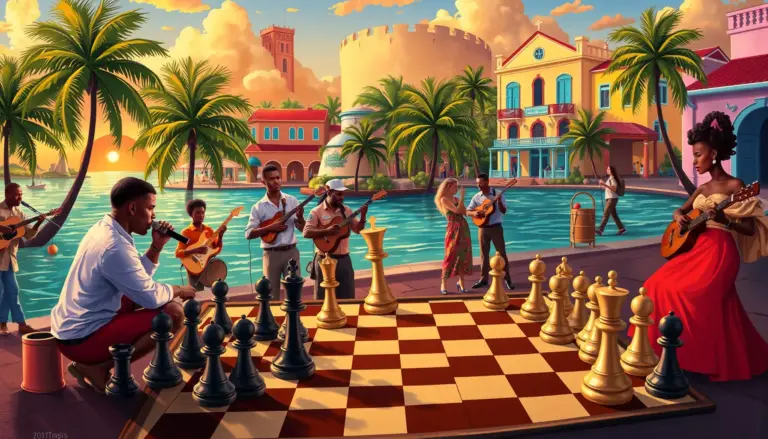
The chess board, that microcosm of 64 casillas, It has ceased to be a simple scene of confrontation and has become a laboratory of human evolution.. In 2026, the ancient game not only resists, but thrives in an unprecedented symbiosis with artificial intelligence, redefining the limits of talent, creativity and even sports ethics. Are we facing the twilight of human genius or, on the contrary, at the dawn of an era where the machine does not compete against man, but accompanies it towards unexplored territories of strategic thinking? The answer, like in every big game, it's not in the pieces, but in how we move them.
The paradox of talent: When AI redefines genius
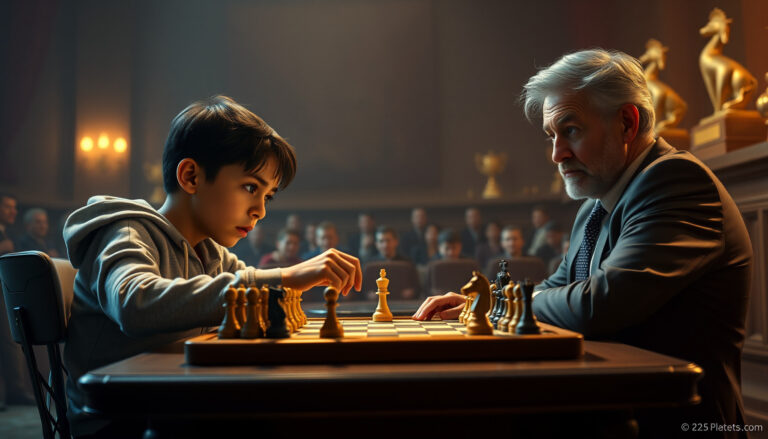
Alireza Firouzja, Gukesh D and Praggnanandhaa are not just the names that dominate the rating FIDE 2025; They are the faces of a generation that has grown up with analysis engines like Stockfish y AlphaZero as training partners. But here lies the paradox: while AI has democratized access to tactical knowledge—allowing a child in Mumbai to study the same lines as a grandmaster in Moscow—, has also raised the bar for what we consider “talent”. It is no longer enough to memorize openings; The true genius lies in the ability to interpret the data that the machine spits out, filtering through algorithmic noise to find original ideas.
This transformation is reminiscent of the moment when Wilhelm Steinitz systematized chess in the 19th century, moving from the romanticism of spectacular sacrifices to a scientific approach. Hoy, AI acts like an accelerated Steinitz, but with a crucial twist: while the Austrian champion searched for universal laws, modern engines reveal that chess is a chaotic system where human creativity remains irreplaceable. Firouzja, For example, not only masters the theoretical variants; las reinterprets, like a musician improvising on a classical score.
The hybrid board: presence and digitalization in tension
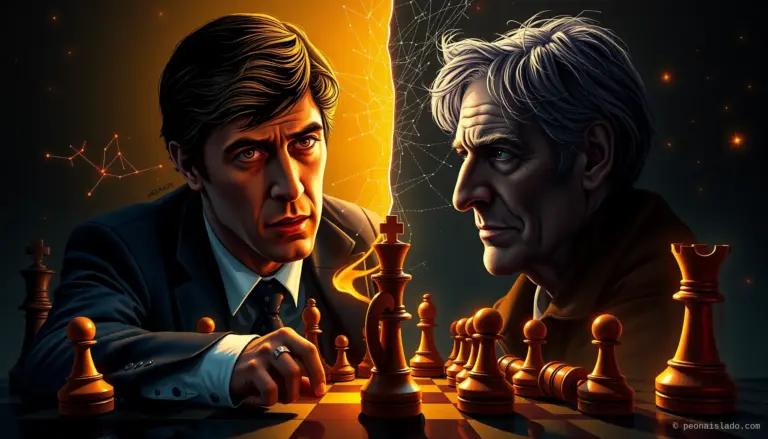
The chess of 2026 It's a two-sided game.: on the one hand, face-to-face tournaments—such as Candidates Tournament— recover the aura of the historical duels of Kasparov vs Karpov, where body language and psychological pressure were as decisive as the movements on the board. On the other, Platforms like Chess.com and Lichess have turned the game into a massive phenomenon, with millions of daily games flowing in real time, from games bullet from one minute to marathons of AI post-mortem analysis.
This duality poses an existential dilemma: Is chess losing its essence as it becomes accessible, or is he fulfilling his destiny as universal language? The answer could lie in how we manage this tension. Tournaments like Chess960 (where the pieces are placed randomly at the beginning) They try to return its creative component to the game, while initiatives such as armenian model —which integrates it into the classrooms— seek to form strategic minds from childhood. The key is not to choose between analog and digital, but in understanding that both are sides of the same coin: chess as a critical thinking tool.
AI as a mirror: What does it reveal to us about ourselves??
When Deep Blue defeated Kasparov in 1997, many interpreted the result as a defeat of human ingenuity. However, in 2026, The relationship with AI has evolved towards a symbiosis. Players no longer fear engines; They use them to explore ideas that not even the great masters of the past could have imagined.. AlphaZero, For example, proved that sacrificing a queen in the opening was not a mistake, but a play optimal in certain positions, challenging centuries of chess dogma.
But this collaboration raises uncomfortable questions: if AI can calculate millions of positions per second, what's left for the human player? The answer lies in what machines no can do: feel the thrill of an accepted gambit, sense the fatigue of the opponent in a five-hour tournament, or create beauty in an ending where pure logic would suggest giving up. As the article points out “Can AI have a passion for chess??”, the game remains a reflection of our humanity, even when we share it with algorithms.
This dynamic is reminiscent of the relationship between chess and music. A composer like Bach could write mathematically perfect fugues, but what makes them immortal is the emotion they transmit. In the same way, a game analyzed by AI can be technically impeccable, but it will lack soul if it does not bear the signature of a player who risks, suffer and, ultimately, vive the game.
The new geopolitics of chess: from the USSR to the global era
For half a century, chess was an ideological battlefield. The USSR used it as propaganda tool, demonstrating the superiority of its educational system. Hoy, the map of chess power is radically different: China, with figures like Ding Liren, has developed a model that combines militarized training with technological innovation; India produces prodigies like Gukesh at an industrial rate; and Europe, with its tradition of schools like german, remains a hotbed of talent.
But the real change is not in the countries, but in how chess has become globalized. The Internet has broken geographical barriers, allowing a child in Kenya to compete on equal terms with a teenager in New York. This democratization, however, It has also created new challenges: the trap with motors It has become an endemic problem., and FIDE struggles to maintain the integrity of the game in an environment where technology advances faster than regulations.
chess, in this sense, has become a microcosm of globalization: a space where the local and the universal converge, the traditional and the disruptive, Fierce competition and unexpected collaboration. As in the geopolitical board, alliances are fluid, and power is not measured only in titles, but in adaptability.
The future: towards a post-human chess?
In 2026, chess is at a crossroads. On the one hand, AI has made gaming more accessible than ever: Any amateur can analyze their games with the same depth as a grandmaster. On the other, This very accessibility threatens to homogenize the style, turning chess into an exercise in memorizing theoretical lines instead of a living art.
The solution could be to embrace what the chess player and philosopher Emil Cioran called “lucidity on the board”: understand that the game is not just a sport, not an art, not a science, but a mirror of our human condition. In a world where AI can calculate the best move, What sets us apart is our ability to choose, even when that choice goes against pure logic.
Perhaps the real challenge is not how to compete with machines, but how to use them to rediscover what makes us human. In that sense, the chess of 2026 It's not the end of an era, but the beginning of another: one where the board is no longer a battlefield, but a space for dialogue between human and artificial intelligence, between tradition and innovation, between cold calculation and burning passion.
As Borges wrote, chess is “an infinite game in a finite space”. In 2026, that space has expanded beyond the 64 casillas, but infinity remains the same: that of the human mind, with all its contradictions, dreams and contradictions.
The future of chess is not written. But if this ancient game teaches us anything, it is that, even in the post-human era, The best games are those where ingenuity, creativity and audacity continue to have the last word.