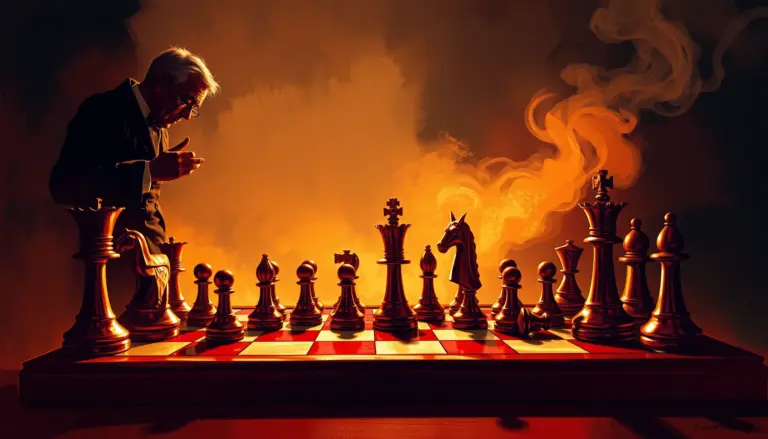
School recess has been, traditionally, a space for physical release and spontaneous socialization. However, in a world where digital hyperstimulation competes with the attention of the youngest, chess emerges as a silent but powerful alternative: and smart recess that transforms the patio into a laboratory for strategic thinking, patience and human connection. It's not just about moving pieces on a board, but to redefine educational leisure, where each game becomes a metaphor for life, and every mistake, in a lesson in resilience. How did this ancient game manage to infiltrate modern school dynamics and change, from the bases, the way children interact, they learn and even resolve conflicts?
Chess as an antidote to digital disconnection
In the era of likes and instant rewards, chess offers something radically different: the opportunity to confront boredom as an ally. Neuroscientific studies, like those cited in Ajedrez and mindfulness, show that gaming activates the prefrontal cortex, the same brain region associated with decision making and emotional control. But its true power lies in what no offers: immediate gratification. Unlike video games, where failure is erased with a reboot, In chess every move has consequences. This feature makes it a unique pedagogical tool, capable of teaching children to tolerate frustration and to understand that progress requires time and reflection.
In schools in countries like Armenia or Spain, where chess is a compulsory subject, the results are eloquent. According to a report from the University of La Laguna, Students who practice chess regularly improve their performance in mathematics and reading comprehension by up to 17%. But beyond the numbers, What is fascinating is how the game reconfigures social relationships. in the yard, the board becomes a magnet: attracts children of different ages, genders and socioeconomic contexts, creating a space where the traditional hierarchy (the strongest, the most popular) is diluted. Here, he “leader” It's not the one who runs the fastest, but who thinks deeper.
From theory to practice: how chess redefines the schoolyard
Implementing chess at recess is not as simple as placing boards on a table. Requires a paradigm shift in the perception of the game: from marginal activity to inclusion tool. In Medellin, For example, he Isolated Pawn Club has shown how chess can be a bridge between vulnerable communities and opportunities. Children who previously spent recess in conflicts now resolve disputes through games, where each movement requires anticipating the consequences, a skill transferable to real life.
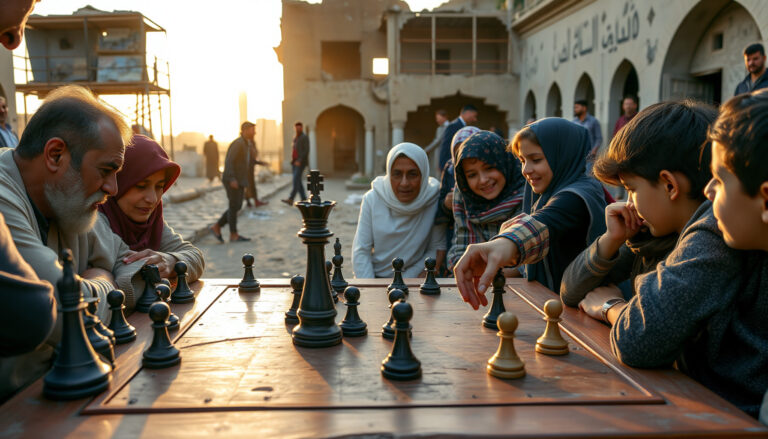
But backyard chess isn't just for “prodigy children” or future grandmasters. Its beauty lies in its democratic accessibility. It doesn't matter if you're shy, extrovert, neurodivergent or speaker of another language: the board does not judge. In multicultural contexts, like those described in chess as a bridge for migrants, The game has become a universal language that transcends language barriers. In a courtyard in Berlin or Stockholm, a Syrian boy and a German boy can communicate without words, establishing a connection that goes beyond the playful.
Besides, chess at recess encourages culture of curiosity. Children don't just play; they observe, analyze and debate games. Questions arise like: “Why did you sacrifice the bishop?” o “What would happen if I had moved the pawn?” This type of interactions stimulates critical thinking and the ability to argue., essential skills in a world where information is abundant but the ability to discern, scarce.
Chess as a mirror of life: lessons that transcend the board
Every chess game is a miniature narrative, with its dramatic turns, their sacrifices and their rewards. But what really transforms the schoolyard is how these dynamics reflect everyday life situations. For example:
- Time management: In rapid chess, children learn to make decisions under pressure, a crucial skill in exams or stressful situations.
- Empathy: Anticipating your opponent's movements forces you to put yourself in their place, developing a deeper understanding of the intentions of others.
- Resilience: A defeat is not the end, but an opportunity to analyze errors and improve. This approach contrasts with the culture of immediacy, where failure is often perceived as something definitive.
In this sense, chess acts as a life simulator. As the article points out chess in life, The thought patterns that develop in front of the board—such as calculating variants or evaluating risks—are directly applicable to decision-making in areas such as studies., personal relationships or even financial management. How many adults wish they had learned to think like this as children??
The challenge of scaling the model: can chess be for everyone?
Despite its benefits, chess at recess faces obstacles. The main one is the cultural resistance: many teachers and parents see it as a game “elite” or too complex for young children. However, initiatives such as how to teach chess to children show that, with playful methodologies (such as the use of stories or pre-chess games), even children of 4 years can enjoy the game without frustration.
Another challenge is the sustainability. It is not enough to introduce chess at recess; It must be integrated into an ecosystem that includes workshops, internal tournaments and teacher training. Countries like India and Azerbaijan have achieved this through public policies that link chess with the school curriculum., proving that, when there is will, the results are tangible. In Spain, For example, Autonomous communities such as the Canary Islands have implemented programs where chess is used as a tool to reduce bullying., with promising results.
Finally, there is the challenge of avoid commoditization. In the era of digital platforms, It's tempting to reduce chess to a quick-consumer product. (like the viral challenges on TikTok). But the true value of schoolyard play lies in its ability to slow down the time, to create spaces where children can think, make mistakes and learn without the pressure of algorithms.
Conclusion: Recreation as a breeding ground for strategic minds
Chess in the schoolyard is not a fad, but one silent revolution that is redefining the concept of educational leisure. In a world where attention is the new gold, this ancient game offers something invaluable: the opportunity to train the mind while socializing, about learning to lose while gaining resilience, and to discover that, sometimes, the smartest move is not the one that wins the game, but the one who teaches to think.
Smart recess is not one where children run aimlessly, but the one where they stop to reflect, to connect and grow. And in that sense, chess is not just a game: is a metaphor for what education should be. because in the end, as the great teacher Savielly Tartakower said, “chess is the gymnastics of the mind”. And what better place to exercise it than in the patio?, where each game can be the beginning of something much bigger.