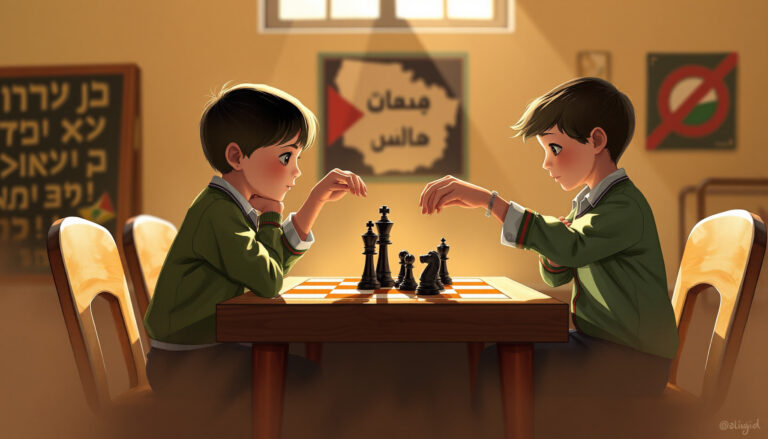
Imagine a classroom where silence is not synonymous with boredom, but of absolute concentration. where the hands, instead of absent-mindedly scribbling in notebooks, They trace precise movements on a canvas of 64 casillas. But this is not just any board.: the pieces, carved from ceiba wood or painted with pre-Columbian motifs, They are the result of weeks of creative work. Students don't just play chess; they reinvent it. this scene, increasingly common in innovative schools, reveals a deep truth: chess is not just a strategy game, but a platform for artistic expression and the critical thinking, where each board design becomes a personal manifesto.
The board as a canvas: when creativity defies the rules
Traditionally, Chess has been a game of rigid rules: the board of 8×8 casillas, pieces with predefined movements, the immutable goal of checkmate. However, when students design their own boards, These rules become a starting point, not in a limitation. In a school project in Medellín, For example, young people from vulnerable neighborhoods created boards inspired by their environment: one represented the map of his commune with pieces that symbolized community leaders, while another used recycled materials to reflect urban resilience. These designs are not mere aesthetic exercises; son statements that merge art and strategy, demonstrating that chess can be a vehicle for cultural identity.
Cognitive psychologist Barbara Tversky, in his book Mind in Motion, argues that physical space—even an abstract one like a chessboard—shapes the way we think. When students redesign the board, They are not just creating a work of art; they are reconfiguring their own perception of the game. A circular board, For example, forces us to rethink concepts like “center” o “flank”, while one with cells of different sizes challenges the notion of strategic balance. These variations are not whims; son thought experiments that deepen the understanding of chess as a complex system.
Strategy beyond the pieces: design as tactical training
Designing a board is not an isolated act of creativity; It is an extension of chess thinking. Let's consider the case of a group of students in Barcelona who, inspired by him link between chess and mathematics, created boards based on fractals. Each square contained a mini-board, replicating the game structure at different scales. This approach was not only visually striking, but also introduced a new level of strategic complexity: Players had to anticipate movements in multiple dimensions, as if they were solving a Rubik's cube in 64 casillas.
These types of projects reveal an uncomfortable truth for chess purists.: innovation in board design does not dilute the essence of the game, but it enriches it. Grandmaster Jonathan Rowson, in his book The Seven Deadly Chess Sins, points out that classical chess often falls into the trap of repetition, where players memorize openings instead of understanding strategic principles. Student-designed boards break this cycle by forcing a constant reinterpretation of the rules. A board with hexagonal squares, For example, eliminates white's advantage in traditional openings, forcing players to develop new tactics from scratch.
Chess as a pedagogical tool: when art teaches strategy
Integrating dashboard design into education is not a luxury, but a necessity in a world where creativity and critical thinking are skills as valuable as mathematics or reading. In a study carried out in schools in Armenia—a country where chess is a mandatory subject—, It was found that students who participated in board design projects showed an improvement in 30% in his ability to solve unconventional chess problems, compared to those who only followed the traditional curriculum. The reason is simple: by creating your own boards, Students internalize the principles of the game in a way that memorization could never achieve.
This approach has a fascinating historical precedent. In medieval Europe, the chessboards were not uniform: some represented mythological battles, while others incorporated astrological elements. These designs were not mere decorations; They reflected the worldview of the time and served as tools to teach military strategy and philosophy.. Hoy, in an educational context, board design serves a similar function: connect chess with the real world. A project in a school in Mexico City, For example, asked students to design boards inspired by pre-Hispanic codices. The result was not only a collection of works of art, but a living lesson on how chess can be a bridge between cultures and times.
The challenge of the purists: innovation or heresy?
Not everyone celebrates this fusion between art and chess. For the traditionalists, the board of 8×8 Casillas is sacred, a legacy dating back to 6th century India. Any deviation, they argue, It's a betrayal of the essence of the game.. However, This position ignores a fundamental fact: Chess has constantly evolved throughout history. the queen, For example, It wasn't always the most powerful piece; in it shatranj lost, its predecessor could only move one square diagonally. It was in 15th century Europe., during the Renaissance, when the queen acquired her current movement, reflecting the growing power of monarchs in society.
Student board design is simply the next phase of this evolution. As chess historian Harold James Ruthven Murray points out in his work A History of Chess, the game has always been a mirror of the culture that surrounds it. In the 21st century, where creativity and adaptability are more valuable than ever, It is logical that chess reflects these priorities. A project at a Tokyo school took this idea to the extreme: students designed boards based on artificial intelligence algorithms, where the pieces moved according to patterns generated by neural networks. The result was a game that, although technically it was still chess, It felt like a completely new experience..
The future of chess: when students rewrite the rules
Student board design is not an isolated phenomenon; It is part of a broader revolution in the way we understand chess. In a world where artificial intelligence dominate the game at a competitive level, The value of chess no longer lies solely in victory, but in its ability to encourage creativity and critical thinking. Student-designed boards are a manifestation of this new era: a reminder that chess is not just a mental sport, but an art form.
This revolution also has profound social implications. In marginalized communities, where access to educational resources is limited, dashboard design becomes an empowerment tool. On a project in Cape Town, young people from townships created boards using recycled materials, such as bottle caps and cardboard. These boards were not only functional, but also served as symbols of resistance and creativity in adverse environments.. As South African educator Jonathan Jansen points out, “chess is not just a game; It is an act of rebellion against poverty and lack of opportunities”.
Board design is also redefining the relationship between chess and technology. At a Silicon Valley school, Students used 3D printers to create boards with pieces that changed shape depending on the phase of the game. This approach was not only innovative from a technical point of view, but also raised fascinating questions about the future of chess: could an adaptive dashboard, that reconfigures in real time, become the next frontier of gaming?
The answer, as always in chess, It depends on how we choose to play. Students Designing Their Own Boards Are Not Destroying the Game; they are expanding their limits, proving that chess is much more than a set of rules. It is a universal language, a pedagogical tool and, above all, a blank canvas waiting to be transformed by the imagination of those who dare to reinvent it.
Chess has survived for more than fifteen hundred years because it has been able to adapt to cultural changes, technological and social. Hoy, in the hands of a new generation of player-artists, is undergoing one of its most exciting transformations. It's not about abandoning tradition., but to enrich it with new perspectives. In the end, as the great teacher Savielly Tartakower said, “chess is a game because of its form, an art for its content and a science for its difficulty”. Students who design their own boards are adding a fourth dimension to this definition.: chess like creative manifesto.
and maybe, in that process, are redefining not only the game, but also the world around him.