Chess with a clock is a ritual that transcends the mere calculation of moves. In each game, time becomes an invisible adversary, a relentless judge who demands not only tactical precision, but also a unique psychological and strategic management. But, What happens when that time is measured with the hands of an analog clock or with the cold digits of a digital one?? The choice between the two is not trivial.: defines the very essence of how we perceive pressure, creativity and even human connection on the board. This article explores the profound differences between these two worlds., beyond the technical, delving into the philosophical, the psychological and the strategic.
The analog clock: the human heartbeat of chess
The analog watch is not just a measuring instrument; It is an extension of classical chess, a bridge between play and tradition. Its mechanism of gears and hands introduces an almost organic dimension to time. Each “tic-tac” resonates as a reminder of finitude, but also of the human cadence. Unlike its digital counterpart, the analog clock does not show the remaining time with millimeter precision, but forces the player to to feel the passing of seconds, to interpret the position of the hands as a visual language.
This apparent ambiguity has strategic consequences. In games with time increase, For example, the player must trust his intuition to calculate how much time he has left, which adds a layer of uncertainty that can be both an advantage and a hindrance. Great teachers like Anatoly Karpov have highlighted how the analog clock encourages a greater connection with the natural rhythm of the game, avoiding the obsession with exact timing that often paralyzes players in quick formats.
But there is something deeper: the analog watch humanizes the pressure. In elite tournaments, where every second counts, The inability to see the exact time forces players to develop a concentration technique more organic. It is not uncommon to see veteran players close their eyes for a few seconds to “listen” the clock, as if time were an ally instead of an enemy. This almost tactile relationship with time contrasts radically with the coldness of digital watches., where every second is counted with surgical precision.
The digital clock: precision as a double-edged sword
The digital clock, for his part, He is a child of the technological age. Its liquid crystal screen leaves no room for doubt: shows the remaining time with an accuracy that eliminates any ambiguity. This precision has obvious advantages. In formats such as blitz or bullet, where every millisecond counts, digital clock allows for more efficient time management. Players can calculate exactly how much time to spend on each move, avoiding unpleasant surprises in the final seconds.
However, This accuracy also has a cost. The digital clock can become a tyrant, especially for those players prone to anxiety. The ability to see the remaining time at all times can lead to an obsession with the clock that distracts from the real goal: the quality of the movements. Studies on psychological errors in chess have shown that players who focus their attention on the digital clock tend to make more tactical errors, especially in complex positions where intuition and creativity are key.
Besides, The digital clock has transformed the dynamics of tournaments. In games with increased time, For example, The clock's precision allows for strategies “time management” that were previously unthinkable. Players like Hikaru Nakamura have perfected the art of “steal” seconds in increments, a tactic that would be impossible with an analog watch. But this extreme optimization of time has also led to a homogenization of the game, where clock management becomes a skill almost as important as calculation ability.
The psychology of time: how each watch shapes the mind
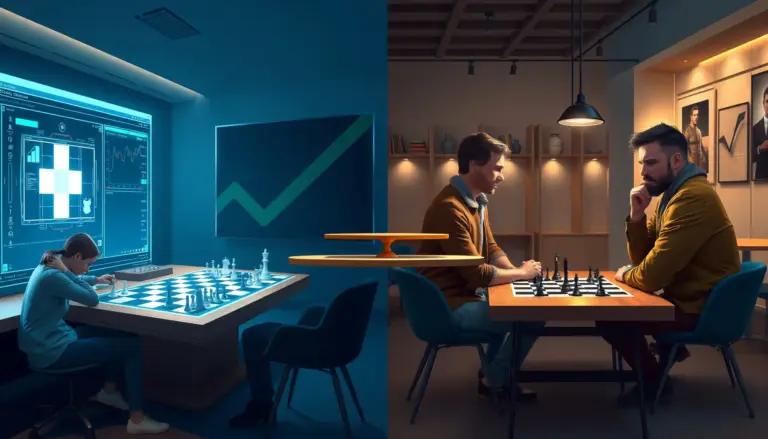
Choosing between analog and digital watch is not just a matter of personal preference; reflects two different philosophies on how to approach chess. The analog clock, with its inherent imprecision, encourages a more relaxed and organic mindset. Players who prefer it tend to be those who value strategic depth over speed, and who see time as a fluid resource, not like a relentless accountant.
Instead, The digital clock attracts players with a more technical and analytical mindset. for them, Time is a resource that must be optimized to the maximum, like in a game of bullet, where every second counts. This mentality can be extremely effective in fast formats, but it can also lead to a disconnection with the creative essence of chess. Players like Magnus Carlsen, Known for his ability to play long games with almost mechanical precision, have shown how the digital clock can be a powerful tool, but they have also warned about the risks of losing the human connection with the game.
A fascinating aspect of this dichotomy is how it affects the perception of the opponent.. With an analog clock, time becomes another element of the game, almost like an extra piece on the board. Players can use the ambiguity of time to generate psychological pressure, For example, making quick moves when the opponent is under temporary stress. Instead, with a digital clock, time is an objective data, which reduces opportunities for mind games and forces players to compete on more technical terrain.
The impact on chess training and evolution
Watch choice also has profound implications for how players train and prepare for competitions.. analog watches, by fostering a more organic connection over time, They are ideal for training in classical chess. Players looking to improve their tactical vision and their deep calculation capacity tend to prefer them, since the imprecision of time forces them to develop a sharper intuition.
On the other hand, Digital watches are essential tools for training in quick formats. Platforms like Chess.com or Lichess use digital clocks with time increments, allowing players to practice time management under conditions similar to those of a real tournament. This practice is crucial for blitz and bullet players., where the speed of decision is as important as the quality of the movements.
But the impact goes beyond individual training. The mass adoption of digital watches has changed the way tournaments are organized. Nowadays, It is rare to find high-level competitions that use analog watches, especially in fast formats. This has led to a standardization of the game, where time management has become a skill as valued as calculation ability. However, Some purists argue that this standardization has taken away the beauty of chess., making it a more technical and less artistic game.
The future: Towards a coexistence or a disappearance?
In an increasingly digital world, The analog watch seems doomed to become a relic of the past. However, its persistence in certain circles, especially among classic and traditional players, suggests that its value goes beyond the functional. The analog clock represents a connection to the history of chess, a way of playing that prioritizes depth over speed, intuition over precision.
On the other hand, the digital clock shows no signs of going away. Its precision and versatility make it indispensable in the modern era, where chess is played on both physical boards and digital platforms. The question is not which of the two watches is better, but how they can coexist in an ecosystem where chess continues to evolve. Maybe the future lies in hybridization: classic tournaments with analog clocks to preserve the essence of the game, and fast competitions with digital watches to adapt to the demands of the digital age.
The truth is that, regardless of the clock used, chess remains a reflection of the human mind. Whether with him “tic-tac” of an analog clock or with the cold digits of a digital one, time continues to be the great invisible adversary, the judge who decides when creativity must give way to precision, and when intuition should prevail over calculation.
Conclusion: time as a mirror of the chess soul
Choosing between an analog and digital watch is not just a matter of technical preference; It is a statement of principles about how we understand chess. The analog clock, with its organic cadence and its ambiguity, reminds us that chess is, first of all, a human game, where intuition, creativity and emotional connection play as important a role as cold calculation. The digital clock, instead, represents the modern era, where precision and efficiency are as valued as strategic depth.
Ultimately, The choice between both clocks reflects a deeper tension in contemporary chess: the fight between tradition and innovation, between humanity and technology. But beyond these differences, What unites both worlds is the very essence of chess: a game where time, whether measured in hands or digits, will always be the great challenge. Learn to master it, regardless of the clock used, It's what separates good players from true masters.. And in that domain, like in chess itself, the true victory is not in beating the rival, but in understanding and controlling time before it controls us.