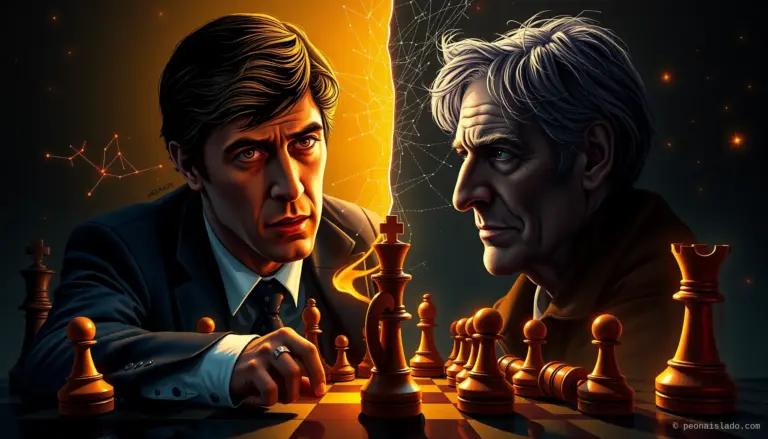
chess, that ancient game that has challenged brilliant minds and shaped strategists throughout history, hides in his 64 squares much more than tactics and openings. Behind the great masters, those who have elevated the board to the category of art, rituals are hidden, manias and superstitions that border on the esoteric. Why does an elite player refuse to change socks during a tournament?? What leads someone to always carry the same amulet in their pocket?? Is it simple coincidence or a psychological necessity in a game where the mind is everything?
In a sport where concentration and pressure can decide a game in seconds, superstitions are not whims, but rather tools of control in an environment where the unpredictable lurks in every movement. From Bobby Fischer to Magnus Carlsen, The great names of chess have developed rituals that, although they seem irrational, play a crucial role: anchor the mind in a state of security when chaos threatens to overwhelm it. This article explores the strangest superstitions of the great masters, unraveling not only its origin, but also its impact on the game and on the psyche of those who master it.
The board as an altar: when luck becomes religion
For many great teachers, the board is not just a battlefield, but an altar where luck and strategy intertwine. Viktor Korchnoi, one of the oldest and most competitive players in history, He was known for his obsession with the objects that accompanied him during games. He never left his old chess clock, whom he considered his “precision talisman”. According to him, that watch, with its constant ticking, It reminded him that time was his ally and not his enemy.. But Korchnoi was not the only one. Mikhail Tal, he “Mago de Riga”, he always carried a red handkerchief in his pocket, a gift from his mother, as he said, gave him “energy to attack”.
These rituals are not mere anecdotes, but manifestations of a well-documented psychological phenomenon: the illusion of control. In a game where chance does not exist—or at least it should not—, players desperately look for any advantage, however minimal. A study published in the Journal of Personality and Social Psychology showed that people tend to attribute positive results to their rituals, even when these have no causal relationship with success. in chess, where a single distraction can cost you a game, These gestures act as mental anchors, reducing anxiety and allowing the player to focus on what really matters: the strategy.
But superstitions are not always harmless. Some players have taken their rituals to the extreme, to the point that they become a burden. The most famous case is that of Bobby Fischer, whose paranoia and obsessions led him to isolate himself from the world. Fischer demanded that the chess pieces be exactly 3.75 inches and that the board was perfectly aligned with the lines of the room. If something didn't meet your standards, he refused to play. Your behavior, although extreme, illustrates how superstitions can become a defense mechanism against uncertainty, especially in a game where defeat is always one move away.
To what extent are these manias useful and when do they become an obstacle?? The answer is not simple. for some, like former world champion Viswanathan Anand, superstitions are part of “mind game”. Anand admitted in an interview that he always carries a small wooden elephant with him., a gift from his wife, why “gives you good luck”. But he also recognized that, in the background, He knows that luck does not exist in chess. What really matters is the preparation, analysis and the ability to remain calm under pressure. However, that elephant is still in his pocket, because in a game where the mind is everything, any psychological advantage is welcome.
The power of objects: amulets that move pieces
If the board is an altar, the objects that surround him are his offerings. Great teachers not only rely on their ability, but also in the amulets that accompany them. Garry Kasparov, possibly the most dominant player in history, He never played without his Montblanc pen. It wasn't just any pen.: It was the same one he had used during his legendary duel against Anatoly Karpov in 1985. Kasparov believed that this pen, with its blue ink and its perfect weight, gave him “mental clarity”. He even went so far as to say that, in moments of doubt, The simple act of holding it helped him visualize the plays better..
But Kasparov is not the only one. Judit Polgár, the best chess player in history, He always wore a necklace with a small chess knight, symbol of his aggressive and dynamic style. for her, that necklace was not just an ornament, but an extension of your identity on the board. “When I wear it, I feel that the horse is with me, ready to jump and attack”, confessed on one occasion. These objects are not simple accessories; They are extensions of the player's personality, tools that remind them who they are and what to do when pressure threatens to paralyze them.
Science supports, in part, this connection between objects and performance. A study from the University of Cologne found that people who wear amulets or perform rituals before a complex task tend to perform better, not because the objects have magical power, but because they reduce anxiety and increase confidence. in chess, where confidence is as important as skill, These rituals can make the difference between victory and defeat. However, They can also become a trap. Sports psychologist Daniel Gould warns that, when a player relies too much on an item or ritual, you risk losing the ability to adapt to unforeseen situations. “If your amulet is lost or broken, what are you doing? Do you give up or keep going?”, Gould asks.. The answer to that question separates the great teachers from the mediocre players..
A fascinating case is that of Alexander Alekhine, world champion in the years 30 y 40, who believed strongly in astrology. Before every important game, He consulted his horoscope and adjusted his strategy accordingly. If the horoscope told you that you should be cautious that day, played defensively; if I indicated that it was a good day to attack, launched risky gambits. Alekhine was not the only one: many players of his time, including Emanuel Lasker, another world champion, They believed in the influence of the stars in the game. Hoy, This practice may seem absurd, but at a time when science had not completely demystified astrology, It was a way of looking for patterns in a game that, in essence, it's about that: find patterns in chaos.
Pre-match rituals: the choreography of concentration
The moment before a chess game is a silent dance where every gesture counts. For the great teachers, This ritual is not optional.: it's a necessity. Magnus Carlsen, the current number one in the world, He has a routine so meticulous that it seems straight out of a neuroscience manual.. Before each game, Carlsen sits in his chair, adjust your posture, take three deep breaths and then stare at the board for exactly 47 seconds. no more, no less. This ritual, that has been perfected over the years, serves to “restart” your mind and enter a state of flow where only the game exists.
Other players have even more elaborate rituals. Vassily Ivanchuk, known for his eccentric genius, walks in circles around the table before sitting down, as if he were measuring the space around him. Then, touch each of the pieces on the board with your fingers, one by one, like I'm telling a secret. Ivanchuk has said that this ritual helps him “feel the game”, to connect with the pieces in a way that goes beyond logic. for him, chess is not just a strategy game, but a sensory experience where touch and intuition play as important a role as calculation.
These rituals are not simple hobbies; They are tools of mindfulness applied to chess. In an article about Ajedrez and mindfulness, Explores how mindfulness can improve performance on the board. Pre-match rituals act as a bridge between the outside world and the mental state necessary to play at the highest level.. By repeating the same gestures over and over again, the player trains his mind to enter a state of absolute concentration, where distractions have no place. It is a form of self-hypnosis, where the body and mind synchronize to face the challenge ahead.
But, what happens when the ritual fails? The case of Nigel Short, one of the best British players in history, It is illustrative. Short had the habit of always drinking a black coffee before each game.. One day, in an important tournament, coffee was not available. Short panicked, His concentration faded and he lost the game in less than 20 movements. This incident led him to rethink his dependence on rituals. “I realized I was using coffee as a crutch”, he later admitted. “Chess is not about what you do before the game, but what you do during it”. Since then, Short has worked to reduce his reliance on rituals, although he still drinks coffee before playing, “out of habit, not out of necessity”.
Superstition as a psychological weapon: when the rival also believes
Superstitions do not only affect the player who practices them; They can also influence their rival. In elite chess, where the mind is as important as the technique, a seemingly innocent gesture can become a psychological weapon. A classic example is that of Anatoly Karpov, who during his reign as world champion in the years 80, He was known for his obsession with cleanliness. Before each game, Karpov meticulously cleaned his chair, your table and even the board with a white cloth. This ritual not only served to feel comfortable, but also to send a message to your rival: “This is my space, and here I set the rules”.
Karpov was not the only one who used superstitions as a psychological tool. Boris Spassky, his eternal rival, He had the habit of always carrying a pocket watch that had belonged to his grandfather.. During his famous duel against Fischer in 1972, Spassky took the watch out of his pocket and placed it on the table before each game.. This gesture, seemingly innocuous, had a clear purpose: remind Fischer that, no matter what happened on the board, time continued its course and, in the end, chess was just a game. Fischer, for his part, responded with his own psychological weapon: refused to play the second game of the match unless a series of absurd demands were met, including the removal of television cameras. The result was chaos, according to many analysts, It affected Spassky more than Fischer..
These examples show how superstitions can become a form of psychological warfare. In an article about chess and war, Explores how the game has historically been used as a military training tool, not only because of its similarity to battlefield strategy, but also for his ability to teach players to handle pressure and read the opponent's intentions.. superstitions, in this context, They are an extension of that psychological war. A player who believes in luck may be more vulnerable to his opponent's tactics, especially if the latter knows how to exploit those beliefs.
But, To what extent are these tactics ethical?? The line between psychological strategy and manipulation is thin. In modern chess, where players are more aware of these mind games, superstitions have lost some of their power. However, there are still those who use them, not so much for its real effect, but as a way to maintain a psychological advantage. Magnus Carlsen, For example, He has admitted that he sometimes exaggerates his pre-match rituals to disconcert his rivals.. “If you think I'm superstitious, It's one less thing they can focus on.”, said in an interview. In a game where the mind is everything, any distraction is a victory.
The dark side of superstitions: when the mind becomes a prison
Although superstitions can be useful, They also have a dark side. When a player depends too much on them, you risk losing control over your own game. The most extreme case is that of Bobby Fischer, whose paranoia and obsessions led him to isolate himself from the world and, finally, to lose his world champion title. Fischer not only demanded specific conditions to play, but also developed conspiracy theories about his rivals. In his last years, he came to believe that the chess pieces were “poisoned” and that his opponents used technology to read his mind. These ideas, although absurd, They were a manifestation of his inability to handle the pressure and uncertainty of the game..
Fischer is not the only one. Many players have fallen into the trap of superstitions, allowing them to dominate your life and career. Russian grandmaster Vasily Smyslov, world champion in the years 50, He believed that his success depended on the position of the stars. Before every major tournament, consulted an astrologer and adjusted his preparation accordingly. Although Smyslov had a brilliant career, his dependence on astrology led him to make irrational decisions, how to reject invitations to tournaments because “the horoscope was not favorable”.
These examples illustrate how superstitions can become a mental prison. In an article about chess and madness, Explores how obsession with gaming can lead players to lose touch with reality. superstitions, in this context, They are a symptom of a deeper problem: the inability to accept that, in chess, there are no guarantees. Every game is a new battle, and victory depends on both the skill and the ability to adapt to the unknown. When a player relies too much on rituals or amulets, is admitting, in the background, who does not trust their own ability to face uncertainty.
But, how do you break this cycle? The answer is not simple. For some players, the solution is therapy. Sports psychologist Ken Ravizza, who worked with several great masters, developed a method to help players reduce their dependence on superstitions. “The first step is to recognize that the ritual has no real power”, explains Ravizza. “The second is to replace it with something that does have it.: self-confidence”. This process is not easy, but it is essential for those who want to reach their full potential. In the end, chess is not about amulets or rituals, but the ability to think clearly under pressure. And that's a skill that can't be bought., not even with the greatest luck in the world.
Conclusion: the game within the game
The superstitions of chess grandmasters are much more than curious anecdotes; They are a reflection of the human mind in its constant search for control in a world of uncertainty.. In a game where every move could be your last, where the pressure and concentration are so intense that they can break even the strongest, These rituals act as psychological lifesavers. They are not magical, but they work because the human mind needs to believe in something, especially when failure lurks around every corner.
However, as we have seen, superstitions also have a dark side. When they become an obsession, can limit a player's potential, transforming from tools of concentration into chains that bind him to irrationality. The key, so, is in balance: use these rituals as support, but never as crutches. In the end, chess is a game of strategy, not luck, and true mastery is not found in an amulet or a horoscope, but in the ability to think clearly, adapt and overcome one's fears.
Perhaps the most valuable lesson these superstitions teach us is not about chess., but about life itself. All, to a greater or lesser extent, we look for patterns and rituals that give us security in an unpredictable world. But true strength is not in what we carry in our pockets or in the gestures we repeat., but in our ability to face the unknown with confidence. On the board and off it, the mind is our best tool, and it's up to us to use it wisely.